Tongue Position for R
Master the retroflex /r/ sound — one of the most challenging English consonants
Tongue Position Illustration
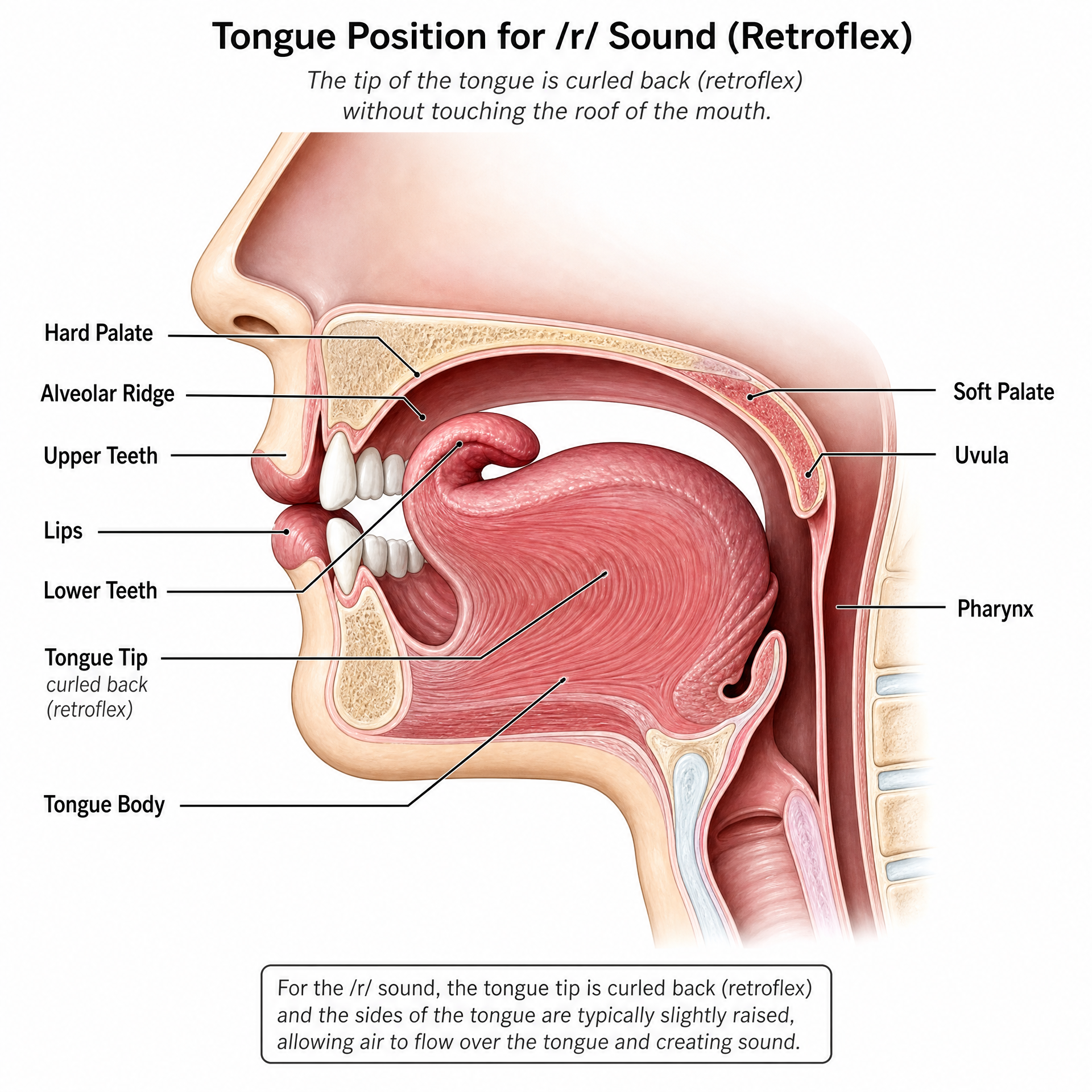
How to Produce the /r/ Sound
The /r/ sound is produced by curling your tongue tip back toward the roof of your mouth (retroflex position) without actually touching it. The sides of your tongue should touch your upper back teeth, creating a narrow passage for air to flow. Your lips should be slightly rounded and relaxed. This is a voiced sound, so your vocal cords vibrate throughout production.
Side View
The tongue tip is curled back and raised, but it does not touch the roof of the mouth. The back of the tongue remains relatively low, allowing air to flow over the tongue.
Front View
Your lips are slightly rounded and protruded. The tongue is not visible between the teeth. Your mouth is slightly open, and the overall appearance is relaxed.
💡 Tip: Many learners make the mistake of touching the roof of the mouth. Remember: the tongue tip should be CLOSE to but NOT touching the palate.
Practice Words for /r/
Listen and repeat these words to practice the /r/ sound in different positions:
Red
Run
Car
River
Around
Bright
Free
Cream
Dress
Try
Right
Grow
Pray
Minimal Pairs: /r/ vs /l/
The /r/ and /l/ sounds are often confused. Practice these pairs to hear and produce the difference:
With /r/
Rice
With /l/
Lice
With /r/
Road
With /l/
Load
With /r/
Free
With /l/
Flee
With /r/
Right
With /l/
Light
With /r/
Rope
With /l/
Lope
With /r/
Bright
With /l/
Blight
Common Mistakes with /r/
-
❌ Mistake: Touching the roof of the mouth with the tongue tip
✓ Fix: Keep the tongue tip CLOSE to but NOT touching the palate. There should be a small gap. -
❌ Mistake: Pronouncing /r/ like /w/ (e.g., "wabbit" instead of "rabbit")
✓ Fix: Curl your tongue tip back; don't round your lips as much as you do for /w/. -
❌ Mistake: Pronouncing /r/ like /l/ (e.g., "light" instead of "right")
✓ Fix: Curl your tongue tip back; don't touch the alveolar ridge like you do for /l/. -
❌ Mistake: Making the sound too tense or guttural
✓ Fix: Keep your tongue relaxed and let air flow naturally over the curled tongue.
Practice Tips for /r/
- 💡 Tip 1: Start by saying "er" (as in "her") to get the tongue position right, then add the initial sound
- 💡 Tip 2: Practice with your tongue slightly visible between your lips to feel the position
- 💡 Tip 3: Use the minimal pairs with /l/ to train your ears to hear the difference
- 💡 Tip 4: Record yourself saying words with /r/ and compare with native speaker audio
- 💡 Tip 5: Practice /r/ in different positions: beginning (red), middle (car), and end (car) of words
Pronunciation Variations
The /r/ sound can vary slightly depending on its position in a word:
- Initial /r/ (beginning of word): "Red" — Strong, clear /r/ sound
- Medial /r/ (middle of word): "Car" — Slightly shorter, still clear
- Final /r/ (end of word): "Car" — Can be slightly softer, especially in some American accents