Tongue Position for W
Master the voiced labial-velar /w/ sound
Tongue Position Illustration
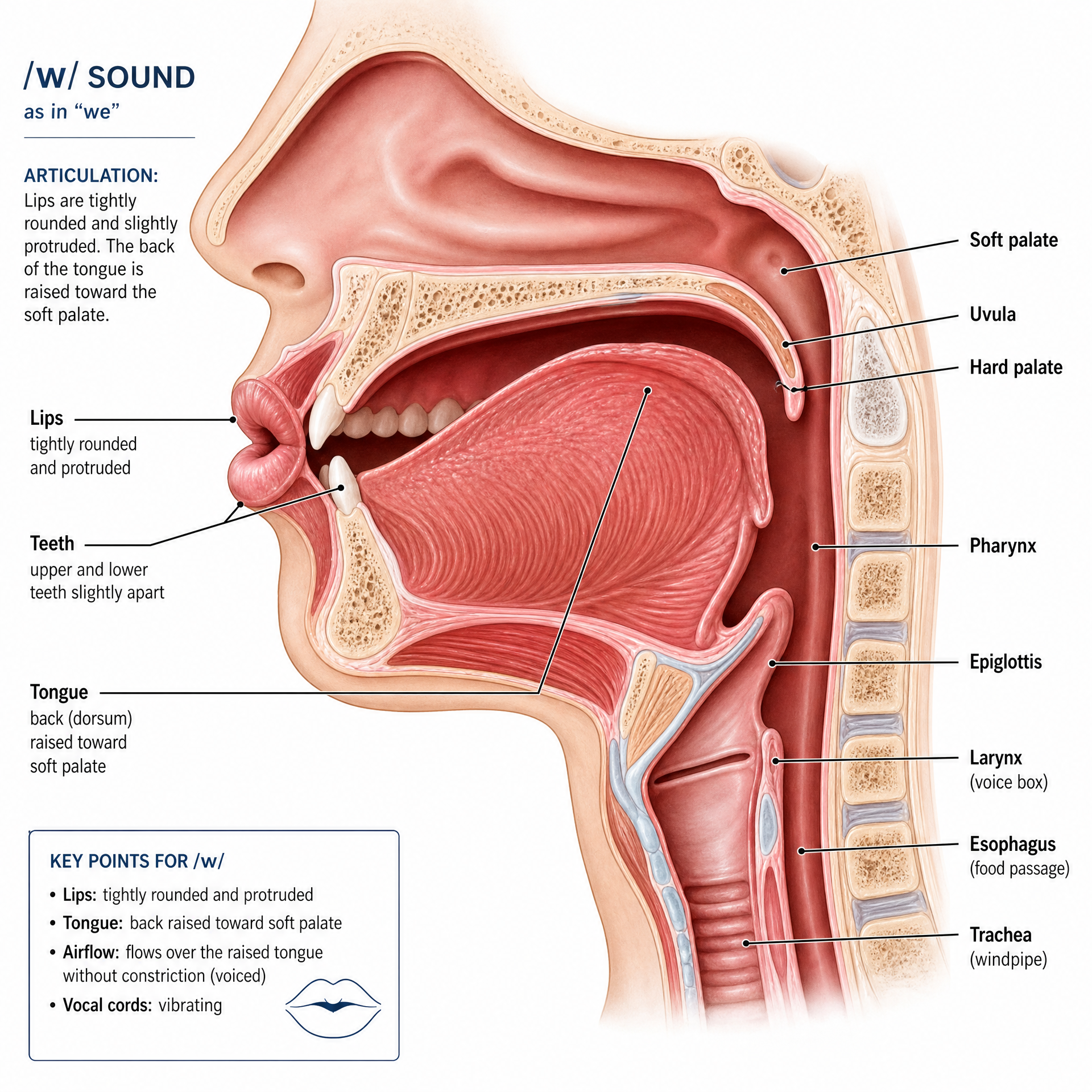
How to Produce the /w/ Sound
The /w/ sound is produced by rounding your lips tightly and raising the back of your tongue toward the soft palate, but without touching it. Your lips are the most important feature - they should be tightly rounded and slightly protruded. This is a voiced sound.
Side View
Lips are tightly rounded and protruded. The back of the tongue is raised towards the soft palate.
Front View
Lips are visibly rounded and pushed forward. The tongue is not visible.
💡 Tip: Think of making a kissing motion with your lips to get the correct rounding.
Practice Words for /w/
Listen and repeat these words to practice the /w/ sound:
Water
Wait
Walk
Wall
Want
Warm
Wash
Watch
Wave
Way
Weak
Wear
Minimal Pairs: /w/ vs /v/
The /w/ and /v/ sounds are often confused. Practice these pairs to hear and produce the difference:
With /w/
Wet
No audioWith /v/
Vet
No audioWith /w/
West
No audioWith /v/
Vest
With /w/
Wine
No audioWith /v/
Vine
With /w/
Wear
With /v/
Veer
With /w/
Wary
No audioWith /v/
Vary
No audioWith /w/
Woe
No audioWith /v/
Vow
Common Mistakes with /w/
-
❌ Mistake: Not rounding the lips enough
✓ Fix: Ensure your lips are tightly rounded and protruded, almost like a small 'o' shape. -
❌ Mistake: Raising the tongue too high (making it sound like /j/)
✓ Fix: The back of the tongue is raised, but not so high that it creates friction like /j/. -
❌ Mistake: Confusing /w/ with /v/
✓ Fix: For /w/, the lips are rounded and there's no contact with the teeth. For /v/, the bottom lip touches the top teeth.
Practice Tips for /w/
- 💡 Tip 1: Practice saying "ooo-ah" quickly to get the lip rounding and tongue movement.
- 💡 Tip 2: Use a mirror to check your lip rounding. It should be very visible.
- 💡 Tip 3: Practice minimal pairs with /v/ to clearly distinguish the two sounds.
- 💡 Tip 4: Record yourself and compare with native speaker audio.