Tongue Position for L
Master the alveolar /l/ sound — a key consonant in English
Tongue Position Illustration
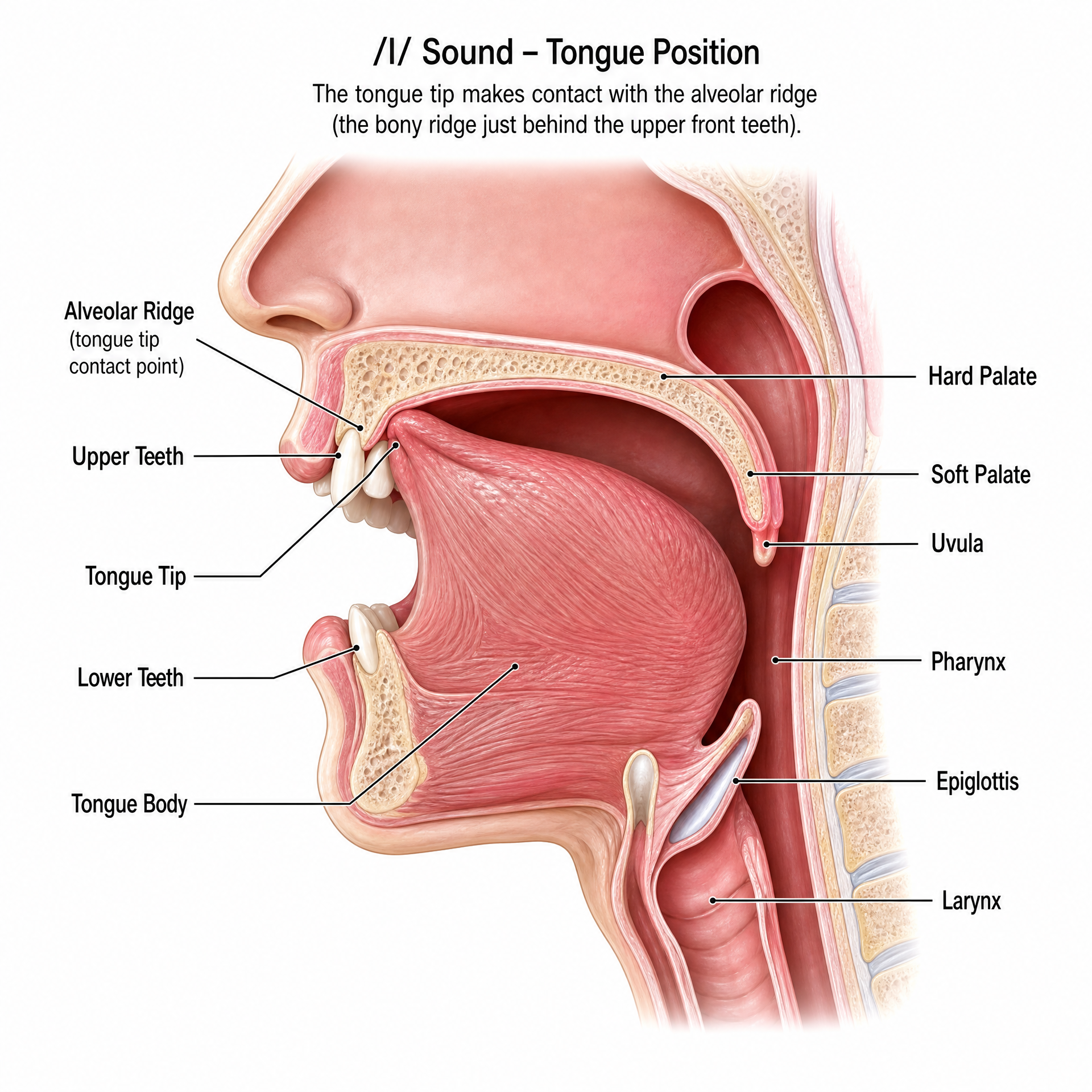
How to Produce the /l/ Sound
The /l/ sound is produced by placing the tip of your tongue on the alveolar ridge (the bumpy area just behind your top front teeth). The sides of your tongue are lowered, allowing air to flow around the sides. Your lips should be slightly rounded and relaxed. This is a voiced sound, so your vocal cords vibrate throughout production.
Side View
The tongue tip is touching the alveolar ridge. The sides of the tongue are lowered to allow air to escape.
Front View
Your mouth is slightly open, and the tongue tip is visible behind the top teeth. The lips are relaxed.
💡 Tip: Ensure the sides of your tongue are down, allowing air to flow. If your tongue blocks all air, you might produce a /d/ sound.
Practice Words for /l/
Listen and repeat these words to practice the /l/ sound in different positions:
Light
Love
Ball
Leaf
Yellow
Lamp
Long
Tall
Milk
Smile
Play
Fly
Minimal Pairs: /l/ vs /r/
The /l/ and /r/ sounds are often confused. Practice these pairs to hear and produce the difference:
With /l/
Light
With /r/
Right
With /l/
Lane
With /r/
Rain
With /l/
Fly
With /r/
Fry
With /l/
Lice
With /r/
Rice
With /l/
Load
With /r/
Road
With /l/
Blight
With /r/
Bright
Common Mistakes with /l/
-
❌ Mistake: Not touching the alveolar ridge with the tongue tip
✓ Fix: Ensure your tongue tip makes firm contact with the bumpy ridge behind your upper front teeth. -
❌ Mistake: Replacing /l/ with /r/ (e.g., "right" instead of "light")
✓ Fix: Remember to touch the alveolar ridge for /l/, unlike the curled-back position for /r/. -
❌ Mistake: Making the sound too dark or velarized (especially at the end of words)
✓ Fix: Focus on keeping the front of your tongue active and the sides lowered. -
❌ Mistake: Blocking all airflow with the tongue
✓ Fix: Allow air to flow freely around the sides of your tongue.
Practice Tips for /l/
- 💡 Tip 1: Feel the alveolar ridge with your tongue tip. It's the key contact point.
- 💡 Tip 2: Practice saying "la-la-la" to get the tongue movement fluid.
- 💡 Tip 3: Use the minimal pairs with /r/ to train your ears to distinguish the sounds.
- 💡 Tip 4: Pay attention to the "light L" (beginning of words like "light") and "dark L" (end of words like "ball").
- 💡 Tip 5: Record yourself and compare with native speaker audio to check your progress.