Tongue Position for TH
Learn the interdental /θ/ and /ð/ sounds — the most challenging for non-native speakers
Two TH Sounds in English
Voiceless /θ/ (theta)
Examples: think, thank, bath, three, month
Voiced /ð/ (eth)
Examples: this, that, mother, breathe, they
Tongue Position Illustration
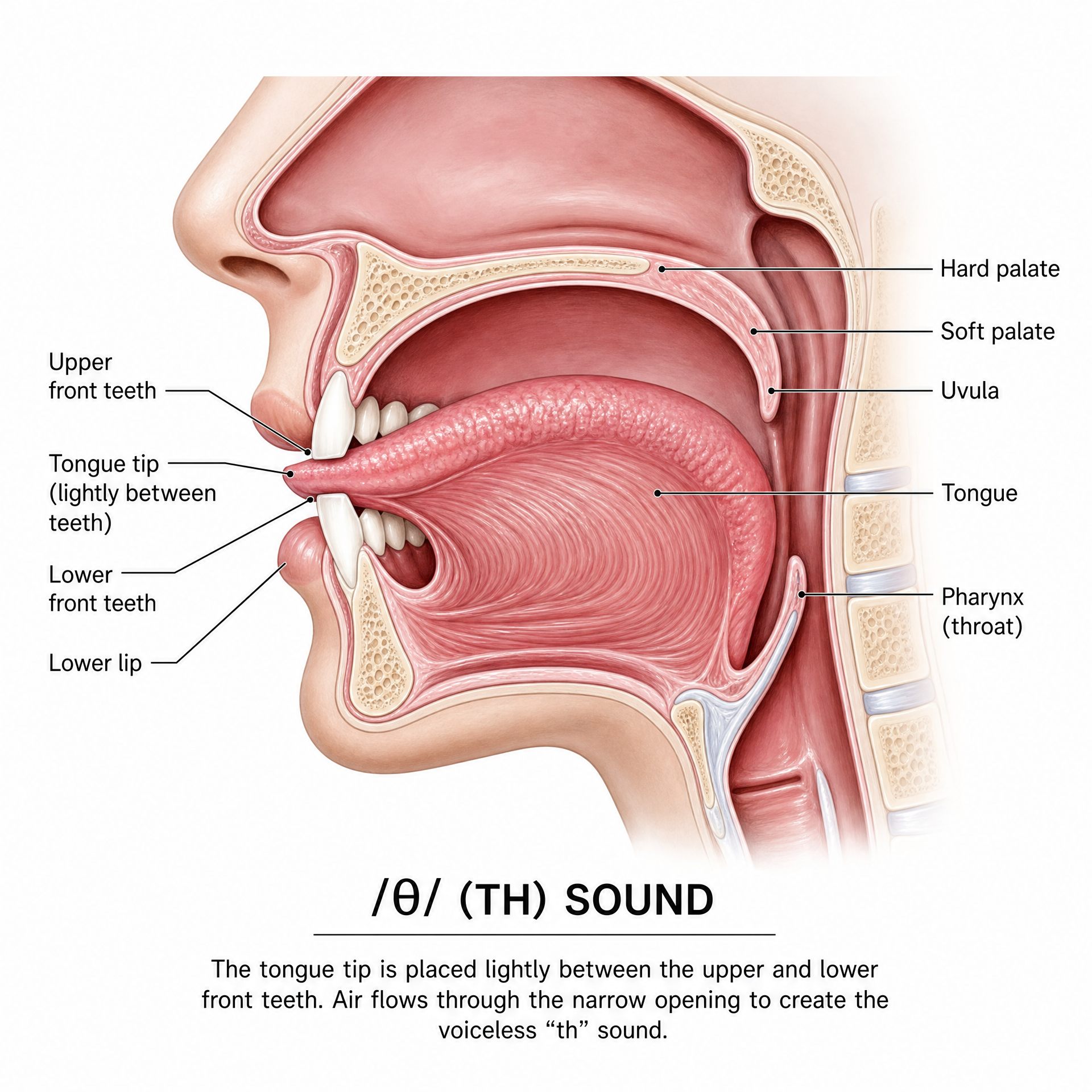
How to Produce the TH Sound
The TH sound is unique because your tongue tip is placed BETWEEN your upper and lower front teeth. This is called an interdental position. The tongue is flat and relaxed, with just the tip visible between the teeth. Air flows between the tongue and the top teeth, creating a slight friction sound. For the voiceless /θ/, your vocal cords do NOT vibrate. For the voiced /ð/, your vocal cords DO vibrate.
Side View
The tongue tip is clearly visible between the teeth. The tongue is flat and the mouth is slightly open. Air flows over the tongue creating the characteristic TH sound.
Front View
You can see the tongue tip between the teeth. The lips are relaxed and slightly open. The overall appearance is natural and not exaggerated.
💡 Tip: The most important thing is to let your tongue tip STICK OUT between your teeth. This is what makes the TH sound unique!
Voiceless /θ/ Practice Words
Practice these words with the voiceless TH sound (tongue between teeth, no vocal cord vibration):
Think
Thank
Bath
Three
Month
Thick
Thin
Tooth
Path
Math
Cloth
Breath
Voiced /ð/ Practice Words
Practice these words with the voiced TH sound (tongue between teeth, with vocal cord vibration):
This
That
Mother
Breathe
They
Them
Then
These
Those
Weather
Feather
Brother
Minimal Pairs: TH vs Other Sounds
Many languages don't have the TH sound, so speakers often substitute it with /s/, /t/, /d/, or /z/. Practice these pairs:
With TH
Thin
Without TH
Sin
With TH
Thought
Without TH
Taught
With TH
Faith
Without TH
Fate
With TH
They
Without TH
Day
With TH
Though
Without TH
Dough
With TH
Then
Without TH
Den
Common Mistakes with TH
-
❌ Mistake: Keeping the tongue inside the mouth (not between the teeth)
✓ Fix: Let your tongue tip STICK OUT between your teeth. This is essential for the TH sound! -
❌ Mistake: Replacing /θ/ with /s/ (e.g., "sink" instead of "think")
✓ Fix: Remember: tongue BETWEEN teeth for TH, tongue BEHIND teeth for S. -
❌ Mistake: Replacing /ð/ with /d/ (e.g., "dis" instead of "this")
✓ Fix: Place your tongue between the teeth and vibrate your vocal cords. -
❌ Mistake: Tensing the tongue too much
✓ Fix: Keep your tongue relaxed and flat. Just let it rest between your teeth.
Practice Tips for TH
- 💡 Tip 1: Look in a mirror while practicing. You should see your tongue tip between your teeth!
- 💡 Tip 2: Start by exaggerating the tongue position, then gradually make it more natural
- 💡 Tip 3: Practice the minimal pairs daily to train your ears and mouth
- 💡 Tip 4: Feel the difference: /s/ (tongue inside), /θ/ (tongue between teeth)
- 💡 Tip 5: Record yourself and compare with native speaker audio to check your progress
Language-Specific Challenges
Many languages don't have the TH sound, which is why it's so challenging for non-native speakers:
- Spanish speakers: Often use /s/ or /t/ instead of /θ/
- Hindi speakers: Often use dental /t/ or /d/ instead of interdental TH
- Arabic speakers: May substitute /s/ or /z/ for TH
- Japanese speakers: Often use /s/ or /z/ since TH doesn't exist in Japanese
- Korean speakers: May use /s/, /d/, or /t/ instead of TH