Tongue Position for F
Master the voiceless labiodental /f/ sound
Tongue Position Illustration
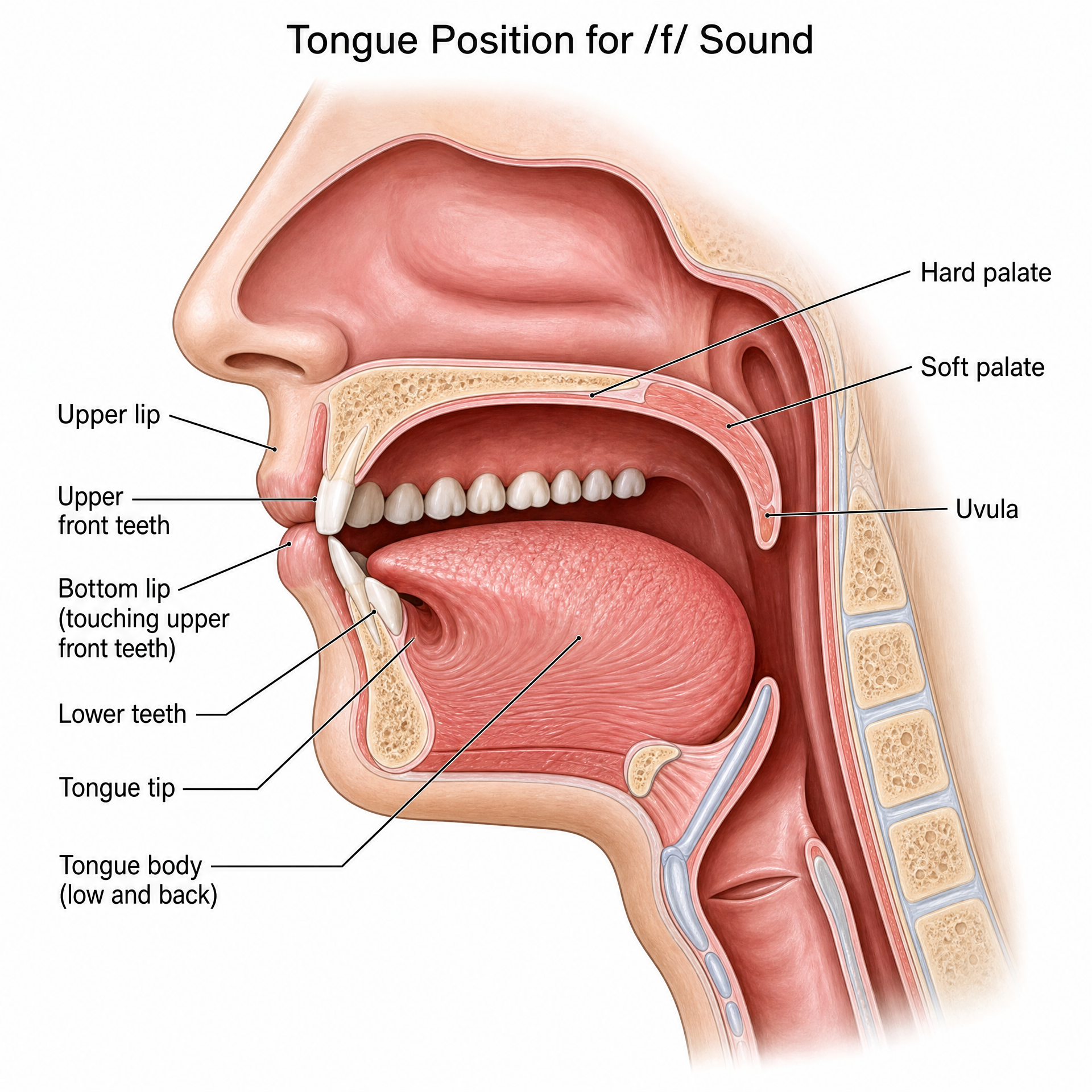
How to Produce the /f/ Sound
The /f/ sound is produced by placing your bottom lip against your upper front teeth. The tongue stays low and relaxed. Unlike /v/, your vocal cords do NOT vibrate. Air flows between the bottom lip and top teeth, creating a soft friction sound.
Side View
The bottom lip touches the upper front teeth. The tongue is low and relaxed.
Front View
The bottom lip is tucked under the top teeth, with a small opening for air to escape. The lips are slightly spread.
💡 Tip: This is the voiceless counterpart to /v/. Practice making the sound without any vocal cord vibration.
Practice Words for /f/
Listen and repeat these words to practice the /f/ sound:
Fast
Face
Off
Phone
Laugh
Fifty
Leaf
Knife
Safe
Soft
Staff
Beef
Minimal Pairs: /f/ vs /v/
The /f/ and /v/ sounds are often confused. Practice these pairs to hear and produce the difference:
With /f/
Fan
With /v/
Van
With /f/
Fat
With /v/
Vat
With /f/
Fear
With /v/
Veer
With /f/
Fain
With /v/
Vain
With /f/
Foes
With /v/
Vows
With /f/
Fined
With /v/
Vined
Common Mistakes with /f/
-
❌ Mistake: Confusing /f/ with /v/ (adding voice)
✓ Fix: Ensure there is no vocal cord vibration. Place your hand on your throat to check. -
❌ Mistake: Placing the bottom lip too far inside the mouth
✓ Fix: The bottom lip should lightly touch the edge of the upper front teeth, allowing air to flow freely. -
❌ Mistake: Making the sound too weak or indistinct
✓ Fix: Ensure enough air pressure is built up between the lip and teeth to create a clear friction sound.
Practice Tips for /f/
- 💡 Tip 1: Practice making a clear /f/ sound, then try to add voice to make a /v/ sound.
- 💡 Tip 2: Use a mirror to ensure your bottom lip is making light contact with your upper teeth.
- 💡 Tip 3: Practice minimal pairs daily to train your ears to distinguish /f/ from /v/.
- 💡 Tip 4: Exaggerate the sound at first to ensure you're making a clear /f/.