Tongue Position for SH
Learn the voiceless postalveolar /ʃ/ sound
Tongue Position Illustration
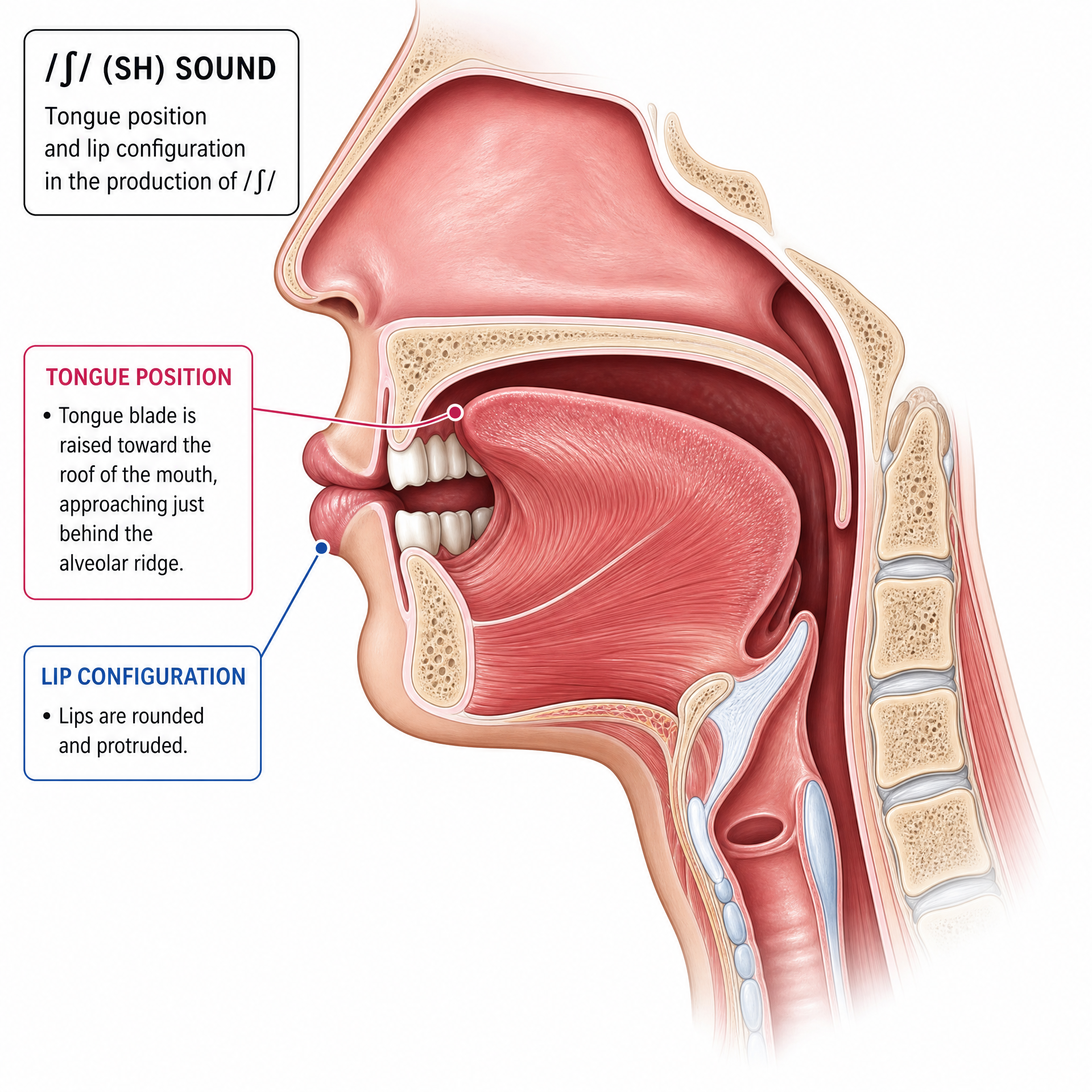
How to Produce the /sh/ Sound
The /sh/ sound is produced by raising your tongue blade toward the roof of the mouth, just behind the alveolar ridge. The sides of your tongue touch the upper back teeth. Your lips are rounded and slightly protruded. This is a voiceless sound, so your vocal cords do NOT vibrate.
Side View
The tongue blade is raised towards the postalveolar region. Lips are rounded.
Front View
Lips are rounded and slightly protruded. The tongue is not visible between the teeth.
💡 Tip: Think of making a 'hushing' sound. This helps to get the right lip rounding and tongue position.
Practice Words for /sh/
Listen and repeat these words to practice the /sh/ sound:
Ship
Shoe
She
Wish
Wash
Push
Brush
Crash
Fresh
Trash
Sharp
Shell
Shop
Short
Shut
Share
Shape
Shake
Minimal Pairs: /sh/ vs /s/
The /sh/ and /s/ sounds are often confused. Practice these pairs to hear and produce the difference:
With /sh/
Ship
With /s/
Sip
With /sh/
Sheet
With /s/
Seat
With /sh/
Show
With /s/
So
With /sh/
Shy
With /s/
Sigh
With /sh/
Sheep
With /s/
Seep
With /sh/
Shop
With /s/
Sop
Common Mistakes with /sh/
-
❌ Mistake: Not rounding the lips enough
✓ Fix: Make sure your lips are visibly rounded and slightly protruded, like you're about to kiss. -
❌ Mistake: Placing the tongue too far back
✓ Fix: The tongue blade should be just behind the alveolar ridge, not deep in the throat. -
❌ Mistake: Confusing /sh/ with /s/
✓ Fix: For /s/, the lips are spread and the tongue is flatter. For /sh/, lips are rounded and the tongue is more raised.
Practice Tips for /sh/
- 💡 Tip 1: Start by saying "shhh" to get the basic sound and lip position.
- 💡 Tip 2: Use a mirror to check your lip rounding. It should be visible.
- 💡 Tip 3: Practice minimal pairs with /s/ to clearly distinguish the two sounds.
- 💡 Tip 4: Record yourself and compare with native speaker audio.