Spanish Speakers: 7 Pronunciation Mistakes That Reveal Your Accent
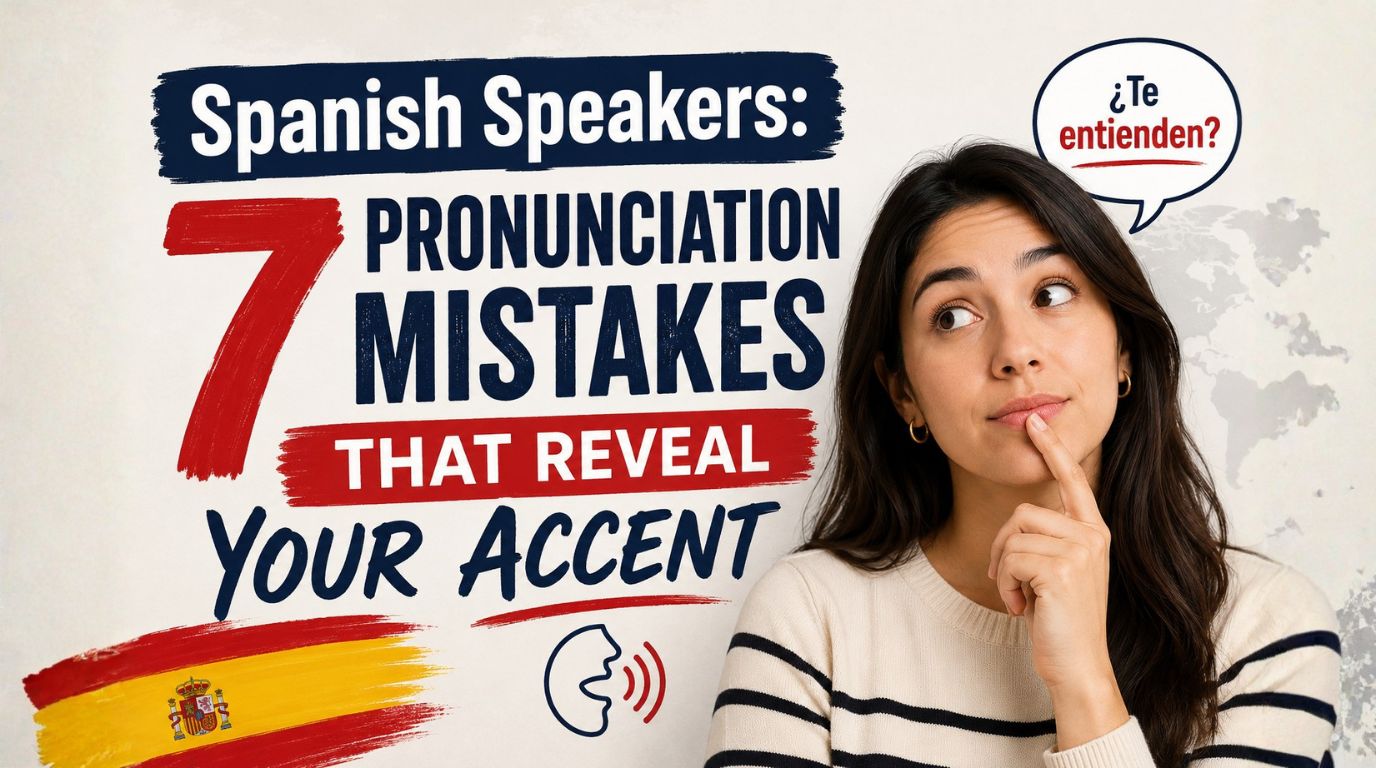
If Spanish is your first language, your English accent is not a problem to “hide.” It is simply the natural result of transferring familiar Spanish sound patterns into a language with a very different vowel system, stress pattern, and consonant inventory. That said, certain pronunciation habits immediately signal Spanish influence, especially in professional communication, presentations, interviews, and international teamwork. The goal is not to erase identity, but to improve clarity and control.
If you want to train intelligently, it helps to study both sides of the equation: the sound habits Spanish naturally encourages and the English targets you want to reach. That is exactly why Accent Help’s guide to how Spanish accents are shaped by vowels, consonants, and rhythm is such a useful companion to English accent work. And if you want to explore broader dialect differences while you practice, the Accent Help accent directory and the Accent Help blog give you a bigger map of how real-world speech varies across English and other languages.
Why These Mistakes Happen
Most of these pronunciation issues come from one of three causes. First, Spanish has a much smaller vowel inventory than English, so Spanish speakers often map several English vowels onto a single familiar Spanish vowel. Second, Spanish phonotactics do not allow some of the consonant clusters English uses easily, especially at the beginnings and ends of words. Third, Spanish is more syllable-timed, while English is stress-timed, which changes how rhythm, reduction, and sentence melody work in connected speech.
Once you see those patterns, the “mistakes” stop feeling random. They become trainable habits. The seven below are especially revealing because they show up in everyday speech, not just in isolated word lists.
1. Dropping Final Consonants and Word Endings
English often ends words with consonants or even consonant clusters, as in text, mind, worked, and friends. Spanish is far less comfortable with these endings, so Spanish speakers may soften, delete, or simplify the final sounds. That leads to forms like tex for text or mine for mind. In fast conversation, these missing endings are highly noticeable because they affect grammar as well as pronunciation.
2. Merging Short and Long English Vowels
Spanish has a clean five-vowel system. English does not. English contrasts many vowel sounds that Spanish learners initially hear as “the same,” including pairs like ship and sheep, full and fool, or man and men. When those distinctions collapse, your speech immediately sounds Spanish-influenced because English listeners rely heavily on vowel differences to identify words.
3. Pronouncing b and v the Same Way
In most Spanish varieties, b and v do not function as strongly contrastive sounds in the way they do in English. As a result, words like berry and very, or boat and vote, often come out too similar. English listeners pick up on this immediately because /v/ in English requires friction between the lower lip and upper teeth, while /b/ is a full lip closure.
4. Adding an Extra Vowel Before Words Like school or street
Because Spanish generally avoids words beginning with s plus another consonant, many Spanish speakers instinctively add an extra vowel before English words like school, Spain, street, or student. That is why eschool and estreet are so common. This is one of the clearest markers of Spanish transfer into English because it affects some of the most common words in the language.
5. Weak or Incorrect h Pronunciation
In Spanish, the letter h is silent, and in some contexts learners overcompensate by producing something closer to the Spanish j sound. English /h/ is neither silent nor harsh. It is simply a soft breath released at the start of the syllable. When it disappears or becomes too heavy, the result stands out immediately in words like house, happy, help, and behind.
6. Replacing English th Sounds With t, d, s, or z
For many Spanish speakers, the English th sounds feel unnatural because they require the tongue to come forward between or against the teeth. English actually has two th sounds: voiceless /θ/ as in think and voiced /ð/ as in this. Spanish speakers often replace them with /t/, /d/, /s/, or /z/, producing forms like tink, dis, or zis. These substitutions are very common and very noticeable. The most efficient drill set is Accent Help’s lesson on how the voiced and voiceless TH sounds work, which breaks down the difference clearly and gives practical mouth-position guidance.
7. Giving Every Syllable Equal Weight
Spanish is more syllable-timed than English, which means syllables tend to receive a more even rhythm. English, by contrast, is strongly stress-timed: content words carry the beat, while function words compress, weaken, or reduce. When Spanish speakers give equal energy to every syllable, English can sound overly careful, flat, or “machine-gun” rhythmic even when the individual sounds are mostly accurate.
How to Practice Without Overcorrecting
Accent work goes wrong when learners try to fix everything at once. A better method is to choose two high-impact targets for two weeks, then add one new target at a time. For many Spanish speakers, the best first combination is one consonant issue and one rhythm issue, such as v/b plus sentence stress, or th plus final consonants. That way you improve intelligibility quickly without overwhelming yourself.
It also helps to hear your own first-language patterns clearly. If you want to notice which Spanish features may be transferring into your English, experiment with Accent Help’s Spanish accent generator and compare those patterns with the English targets you are trying to reach. That comparison often makes interference more obvious than abstract theory alone.
Final Thoughts
Spanish speakers do not reveal their accent through one dramatic mistake. They reveal it through a cluster of small, consistent patterns: simplified endings, merged vowels, /b/ and /v/ confusion, extra vowels before consonant clusters, weak /h/, substituted th sounds, and syllable-timed rhythm. The good news is that every one of those patterns can be improved with focused drills and better listening. If you want to go deeper after this article, a strong next step is to read Accent Help’s guide to how Spanish accents are built, work through the TH sound drills, and keep exploring the wider Accent Help blog and accent directory to sharpen both your ear and your control.