French Accent in English: The 5 Biggest Mistakes & Fixes

A French accent in English can sound elegant, distinctive, and memorable. But for many French speakers, the goal is not to erase identity. It is to become easier to understand in meetings, interviews, classrooms, and everyday conversation. That is why the real challenge is not “sounding less French” in a vague sense. The challenge is identifying the specific pronunciation habits that reduce clarity and then fixing them one by one.
The good news is that most French accent issues in English are highly predictable. They come from a small set of sound differences between the two languages. Once you understand those patterns, improvement becomes much faster. If you want to explore pronunciation training beyond this article, the broader collection of accent practice resources can help you compare tools and exercises for English and other language backgrounds.
Why French Speakers Struggle with Certain English Sounds
French and English share a large amount of vocabulary, but they do not share the same sound system. English depends heavily on stress, vowel contrast, and consonant release. French, by comparison, is more even in rhythm and often smoother in word endings. As a result, French speakers may pronounce English in ways that feel natural from a French perspective but less clear to native English listeners.
That does not mean every feature of a French accent is a problem. In fact, many features are perfectly understandable. The biggest issues are the ones that change word identity, blur sentence rhythm, or make important sounds disappear. Below are the five mistakes that matter most, along with practical fixes you can apply immediately.
Mistake #1: Replacing English “th” with “z,” “s,” or “d”
One of the most recognizable French accent patterns in English is difficulty with the two “th” sounds. Words like think, thank, and three may come out closer to sink, sank, or tree. Words like this, that, and those may sound more like zis, dat, or doze.
This happens because the English “th” sounds do not exist in standard French. Speakers naturally substitute a nearby sound from their first language. The problem is that in English, these substitutions can change meaning or force the listener to work harder than necessary.
Mistake #2: Flattening English Vowels
English has a wider and more unstable vowel system than French. Many English vowels shift in length, tension, and mouth position in ways that French speakers may not expect. That often leads to compressed vowel distinctions. For example, ship and sheep, or full and fool, may sound too similar.
This is one of the biggest intelligibility issues because vowels carry a huge amount of meaning in English. If the listener cannot clearly hear the difference between two nearby vowel sounds, entire words may become ambiguous.
If you want more pronunciation-focused reading after this article, browsing the accent learning blog archive is a useful next step because it helps learners connect individual sound problems to broader speech patterns.
Mistake #3: Weak or Missing Word Stress
English is a stress-timed language. Some syllables stand out strongly, while others become shorter and weaker. French rhythm works differently, so French speakers often give each syllable a more even weight. The result can sound smooth, but in English it may also sound less natural and less easy to process.
Stress mistakes are especially noticeable in longer words. A speaker may pronounce every syllable clearly but still sound difficult to follow if the main stress falls in the wrong place. Words such as development, information, and opportunity depend on stress to sound recognizable.
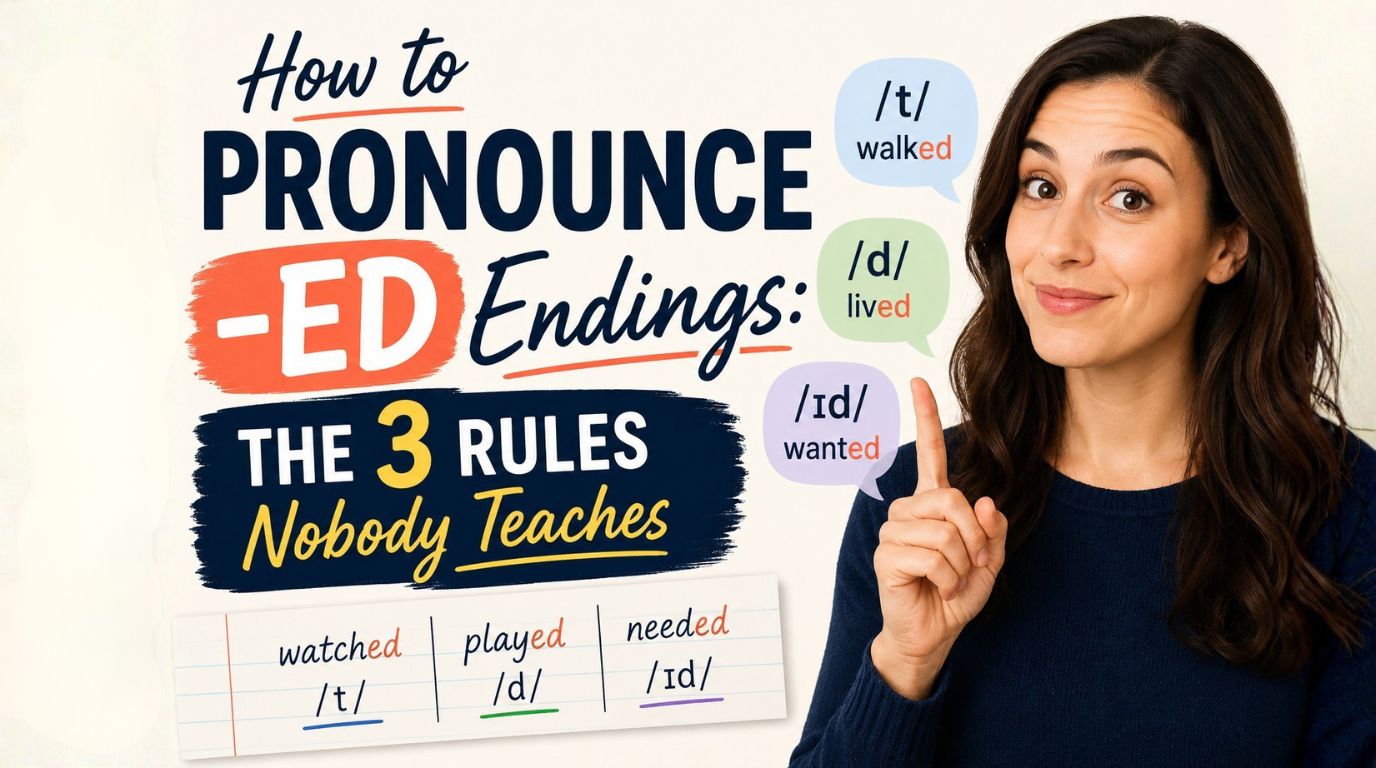
Mistake #4: Dropping or Softening Final Consonants Too Much
French often handles final consonants differently from English. In connected speech, French speakers may reduce or soften English endings in a way that feels natural to them but makes key grammatical information harder to hear. This can affect plural forms, past tense endings, and basic word identity.
For example, if the final sound in worked, needs, or big is not fully released, the sentence may lose precision. In professional situations, these tiny losses can add up quickly because endings often carry tense, number, and contrast.
Mistake #5: Using French Sentence Melody in English
Even when individual sounds are accurate, a French speaker may still sound strongly accented in English because of sentence melody. English relies on pitch movement, stress focus, and reduction of less important words. French speakers often transfer a more even, flowing intonation pattern, which can make English sound less dynamic or sometimes less clear in emphasis.
This matters because listeners do not only hear words. They hear structure. Intonation tells them what is new, important, uncertain, contrastive, or complete. If the melody does not match the message, the sentence may feel flat or harder to interpret.
The Best Way to Improve Faster
The most efficient path is to stop treating accent improvement as a single giant problem. It is not one problem. It is a collection of smaller, trainable habits. A French speaker who improves the “th” sounds, sharpens vowel contrast, strengthens word stress, completes final consonants, and adjusts sentence melody will usually become far easier to understand without losing personality or confidence.
It also helps to train with real phrases instead of random word lists. Accent improvement becomes more durable when sounds are practiced inside the kinds of sentences you actually use at work and in conversation. For learners who want to go further, exploring other pronunciation and speech tools through the main accent resource hub can make it easier to build a broader training routine.
A Simple Practice Routine
A practical weekly routine can be very simple. Spend one day on consonants, one day on vowel contrasts, one day on word stress, one day on endings, and one day on sentence melody. Then use the final two days to review everything in real spoken paragraphs. This kind of repetition creates much better results than occasional unfocused practice.
- Choose one problem area at a time.
- Practice with minimal pairs and short phrases.
- Record yourself and compare clarity, not perfection.
- Repeat the same sentences until the correction feels natural.
Consistency matters more than intensity. Ten focused minutes a day on the right error pattern is usually more valuable than a long session with no clear target.
Final Thoughts
A French accent in English is not a flaw. But some pronunciation habits make communication less efficient than it needs to be. The smartest approach is to keep the parts of your accent that reflect identity while correcting the parts that interfere with understanding. That is what real accent training is about.
If you focus on the five areas above, you will already be working on the issues that matter most: “th” sounds, vowel contrast, word stress, final consonants, and intonation. Once those improve, your English will sound clearer, more confident, and more natural in the situations that count most.