Silent Letters in English: A Full List With Examples
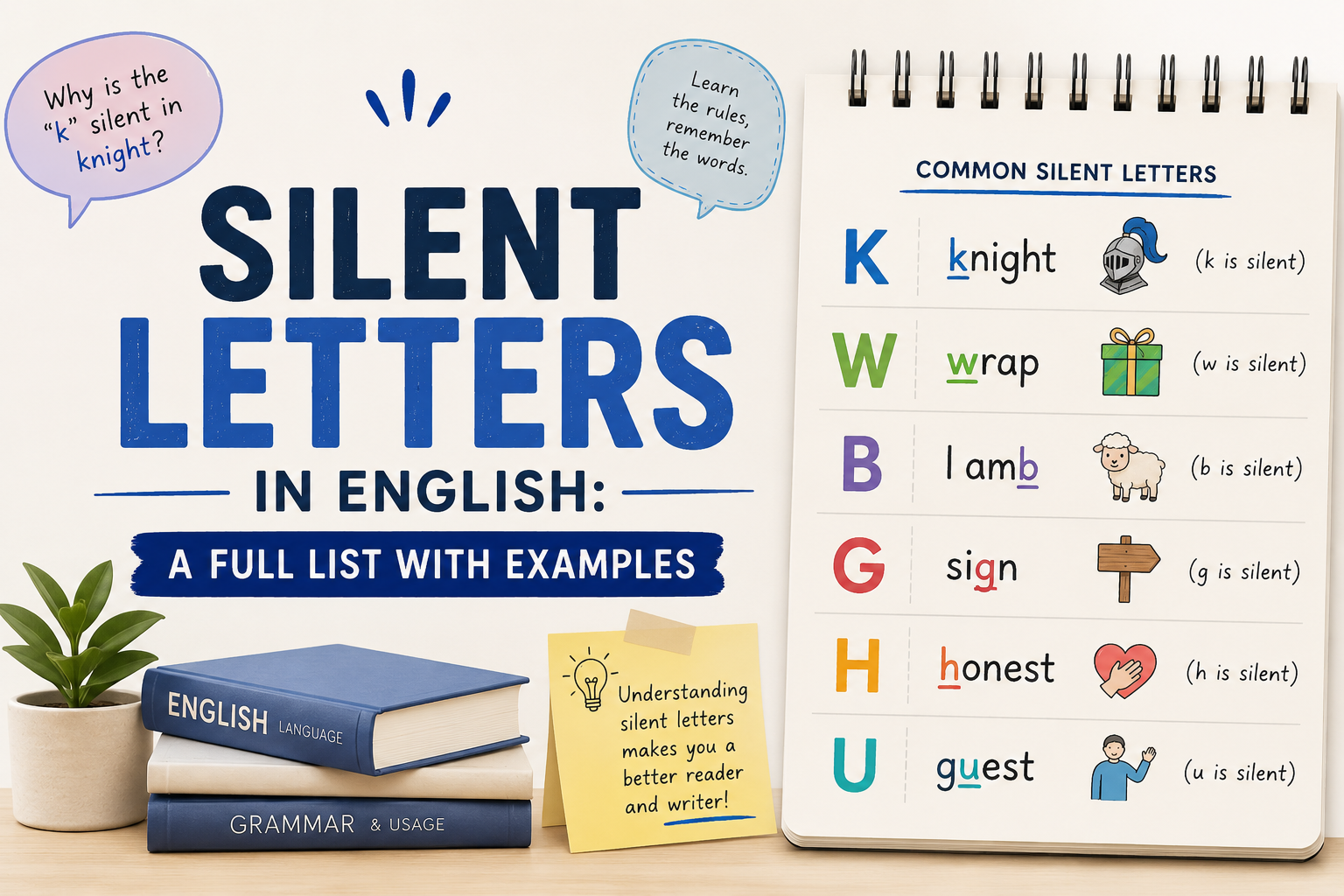
Silent letters are one of the biggest reasons English spelling and pronunciation can feel unpredictable. A word may contain a letter that is written clearly on the page but never fully pronounced in natural speech. For learners, that creates two challenges at once: spelling words correctly and saying them naturally. The good news is that silent letters are not random. Many of them follow recognizable patterns that become much easier to remember once you see them grouped by letter and sound.
In this guide, you will find a full list of the most common silent letters in English, along with examples, pronunciation notes, and memory tips. If you are also working on broader pronunciation habits such as stress, rhythm, and accent clarity, exploring the wider collection of accent and pronunciation resources can help you connect spelling patterns to real spoken English. You can also browse the Accent Help blog for related pronunciation articles if you want to keep building your listening and speaking accuracy.
What Are Silent Letters?
A silent letter is a letter that appears in the spelling of a word but is not pronounced when the word is spoken. For example, the b in lamb, the k in knife, and the w in write are all silent. These letters often remain in modern spelling because of the history of the language, earlier pronunciation patterns, or influence from Latin, French, Germanic, and other language sources.
Why English Has So Many Silent Letters
English developed through centuries of sound change, borrowing, and spelling standardization. Some letters were once pronounced but gradually disappeared in speech. In other cases, words were borrowed from other languages and kept older spellings even after pronunciation shifted. That is why silent letters are best learned as patterns rather than as isolated spelling mistakes. When you recognize a recurring structure such as kn-, wr-, or -mb, you start to predict pronunciation much more confidently.
A Full List of Common Silent Letters in English
Below are the most common silent-letter patterns that learners encounter in everyday English.
1. Silent B
The letter b is often silent after m at the end of a word.
- lamb — pronounced like lam
- comb — pronounced like cohm
- thumb — pronounced like thum
- climb — pronounced like clime
- doubt — the b is silent in this common word as well
A helpful memory pattern is that -mb at the end of a word usually drops the b in pronunciation.
2. Silent C
Silent c often appears before k or in certain learned or borrowed words.
- scissors — the c is silent
- muscle — the c is silent
- scene — the c is silent
- scent — the c is silent
Learners often notice that sc- words are especially inconsistent, so these are good candidates for memorization through repeated listening.
3. Silent D
Silent d is less common but still important in high-frequency words.
- handkerchief — the d is typically silent
- Wednesday — often pronounced like Wenz-day or Wednes-day with a very weak d
- sandwich — the d is often dropped in fast speech
Some silent d examples vary slightly by accent and speaking speed, which makes them useful pronunciation practice items rather than simple spelling rules.
4. Silent G
The letter g is commonly silent before n in many words.
- gnome — pronounced nome
- gnat — pronounced nat
- sign — the g is silent
- foreign — the g is silent
- design — the g is silent
Be careful with word families. In sign, the g is silent, but in signature, the sound returns. That is one reason learners benefit from studying pronunciation through related word groups.
5. Silent GH
The letter combination gh is one of the most confusing patterns in English because it can be silent, pronounced as f, or occasionally heard in older or specialized words.
- night — gh is silent
- light — gh is silent
- daughter — gh is silent
- though — gh is silent
- laugh — gh sounds like f, so it is not silent here
This pattern is worth learning carefully because the spelling is common, but the pronunciation is not consistent from word to word.
6. Silent H
Silent h appears in several common words, especially words influenced by French or older spelling conventions.
- hour — pronounced our
- honest — pronounced onest
- honor — the h is silent
- heir — pronounced like air
These words are especially important because they affect article choice in speech. For example, we say an hour, not a hour, because the word begins with a vowel sound.
7. Silent K
The letter k is usually silent before n at the beginning of a word.
- knife — pronounced nife
- knee — pronounced nee
- know — pronounced no
- knock — pronounced nock
- knit — pronounced nit
This is one of the easiest silent-letter patterns to recognize. When a word starts with kn-, the k is usually not pronounced.
8. Silent L
Silent l appears in several very common everyday words.
- calm — the l is silent
- half — the l is silent
- walk — the l is silent
- talk — the l is silent
- should — the l is silent
- would — the l is silent
- could — the l is silent
Because could, would, and should are so frequent in conversation, mastering this silent l pattern can immediately make your spoken English sound more natural.
9. Silent N
Silent n appears in a smaller group of familiar words, often after m.
- autumn — the final n is silent
- column — the final n is silent
- hymn — the final n is silent
- solemn — the final n is silent
10. Silent P
Silent p is common in words beginning with ps-, pn-, or pt-, especially in words from Greek origin.
- psychology — the p is silent
- pneumonia — the p is silent
- pterodactyl — the p is silent
- receipt — the p is silent
Academic vocabulary often includes this pattern, so students reading science, medicine, or psychology will see silent p words frequently.
11. Silent S
Silent s appears in a few important words that learners commonly mispronounce when reading aloud.
- island — the s is silent
- aisle — the s is silent
- debris — in English, the final s is silent
12. Silent T
Silent t is especially common in clusters that are difficult to pronounce smoothly.
- listen — the t is silent
- castle — the t is silent
- whistle — the t is silent
- fasten — the t is silent
- often — the t may be silent in many accents, though some speakers pronounce it
Some words such as often show accent variation, which is a good reminder that pronunciation can differ across English varieties. That is one reason learners may find it useful to compare pronunciation patterns through broader accent practice materials for different forms of English speech.
13. Silent U
Silent u is less frequent, but it appears in a few well-known word patterns.
- guess — the u is silent
- guitar — the u is silent
- guard — the u is silent
- guest — the u is silent
In many of these words, the u helps signal how the preceding consonant should be read, even though it does not produce a full vowel sound itself.
14. Silent W
The letter w is often silent before r at the beginning of a word, and in a few other common forms.
- write — pronounced rite
- wrong — the w is silent
- wrist — the w is silent
- wrap — the w is silent
- who — in this word, the w is silent
Like kn-, the wr- pattern is one of the easiest silent-letter combinations to spot in written English.
Quick Reference Table
| Silent Letter | Common Pattern | Examples |
|---|---|---|
| B | -mb | lamb, thumb, comb |
| G | gn-, -gn | gnome, sign, design |
| H | initial h- in select words | hour, honest, honor |
| K | kn- | knife, know, knee |
| L | -alk, -ould, calm/half | talk, would, half |
| P | ps-, pn-, pt- | psychology, pneumonia, pterodactyl |
| T | -stle, -sten | castle, listen, fasten |
| W | wr- | write, wrong, wrist |
How to Learn Silent Letters More Easily
The most effective strategy is to learn silent letters in patterns, not one word at a time. Start with high-frequency groups such as kn-, wr-, -mb, and -ould. Then practice reading and saying those words aloud in short sentences. When you train your ear and your mouth together, the spelling becomes much easier to remember.
It also helps to notice families of related words. For example, sign has a silent g, but signature does not. Seeing that contrast teaches you that pronunciation in English is influenced by word history, not just surface spelling. If you enjoy learning through examples and pronunciation-focused explanations, reading more articles in the Accent Help pronunciation blog archive can give you more practice with the kinds of spelling patterns that affect real speech.
Memory tip: If a silent-letter pattern appears in several common words, treat it as a pronunciation rule first and a spelling detail second.
Common Mistakes Learners Make
One common mistake is pronouncing every written letter because the spelling looks transparent. That often leads to forms like pronouncing the k in knife or the b in thumb. Another mistake is memorizing a word visually but never connecting it to spoken English. Silent letters become much easier when you repeatedly hear and say the word, rather than studying it only on the page.
Learners should also remember that some words vary across accents. A word like often may be pronounced with or without the t, depending on the speaker and dialect. That does not mean the rule has failed. It means English pronunciation includes regional patterns, which is why a wider view of different English accent resources and pronunciation models can be useful as your listening range grows.
Practice Sentences With Silent Letters
- The knight wrote a long note at night.
- She knows the answer, but she would not talk.
- An honest man climbed the hill at dawn.
- Please listen carefully and fasten your seat belt.
- The psychologist explained the design of the study.
Sentences like these help you see several silent-letter patterns at once. They are especially useful for reading aloud, dictation, and listening practice.
Final Thoughts
Silent letters are a permanent part of English spelling, but they do not have to remain confusing. Once you organize them by pattern, they become much more manageable. Start with the most common forms such as kn-, wr-, -mb, and silent h words, then expand into the less frequent cases. Over time, you will begin to predict pronunciation more naturally and spell with more confidence.
If you want to keep improving beyond silent letters, a smart next step is to explore the broader Accent Help pronunciation and accent resource hub and continue reading the latest pronunciation articles on the Accent Help blog. That way, spelling patterns, word stress, listening accuracy, and clear speech can all improve together.