Tongue Position for IH
Produce the short front vowel /ɪ/ sound
Tongue Position Illustration
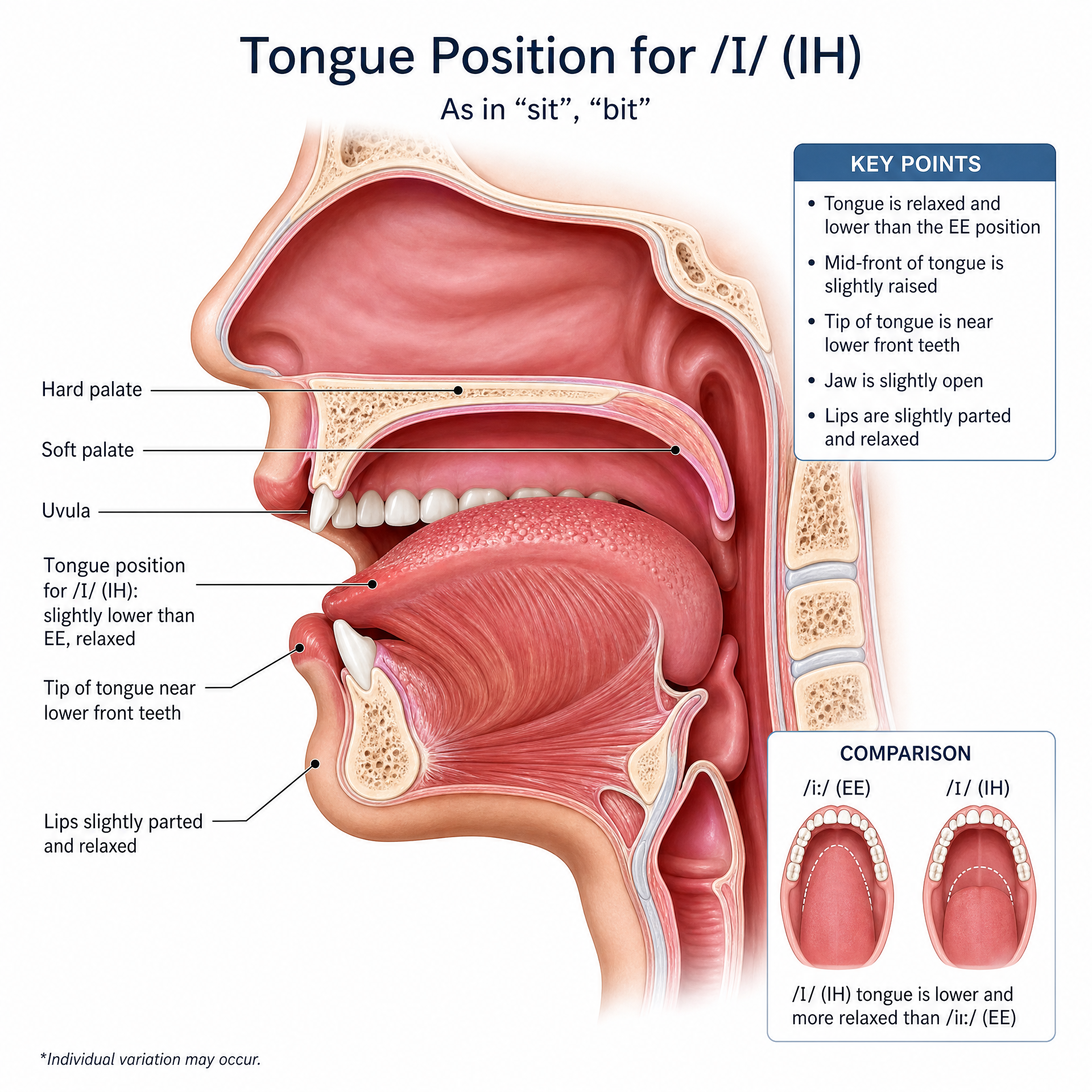
How to Produce the /ih/ Sound
The /ih/ sound is produced by raising your tongue slightly lower and more relaxed than the /ee/ sound. Your lips are neutral, not spread as wide. The jaw is slightly more open than for /ee/. This is a short vowel sound, so it should be held for a shorter duration.
Side View
The tongue is slightly lower and more relaxed than for /ee/. Lips are neutral.
Front View
Lips are neutral, slightly parted. The jaw is slightly more open than for /ee/.
💡 Tip: This is a relaxed, short vowel. Don't tense your tongue or spread your lips too wide.
Practice Words for /ih/
Listen and repeat these words to practice the /ih/ sound:
Sit
Ship
Bit
Kick
Mitt
Slip
Thin
Chip
Sit
Ship
Slip
Minimal Pairs: /ih/ vs /ee/
The /ih/ and /ee/ sounds are often confused. Practice these pairs to hear and produce the difference:
With /ih/
Bit
With /ee/
Beat
With /ih/
Ship
With /ee/
Sheep
With /ih/
Slip
With /ee/
Sleep
With /ih/
Sit
With /ee/
Seat
With /ih/
Kick
With /ee/
Keep
With /ih/
Mitt
With /ee/
Meet
Common Mistakes with /ih/
-
❌ Mistake: Raising the tongue too high (making it sound like /ee/)
✓ Fix: Relax your tongue slightly. It should be lower than for /ee/. -
❌ Mistake: Not relaxing the tongue enough
✓ Fix: This is a lax vowel. Keep your tongue muscles relaxed. -
❌ Mistake: Confusing /ih/ with /ee/
✓ Fix: For /ih/, the lips are neutral. For /ee/, they are spread in a smile.
Practice Tips for /ih/
- 💡 Tip 1: Practice saying words like "it" or "in" with a relaxed mouth.
- 💡 Tip 2: Use a mirror to ensure your lips are neutral, not spread.
- 💡 Tip 3: Practice minimal pairs with /ee/ to clearly distinguish the two sounds.
- 💡 Tip 4: Record yourself and compare with native speaker audio.