Word Stress in English: Why It Matters More Than Pronunciation
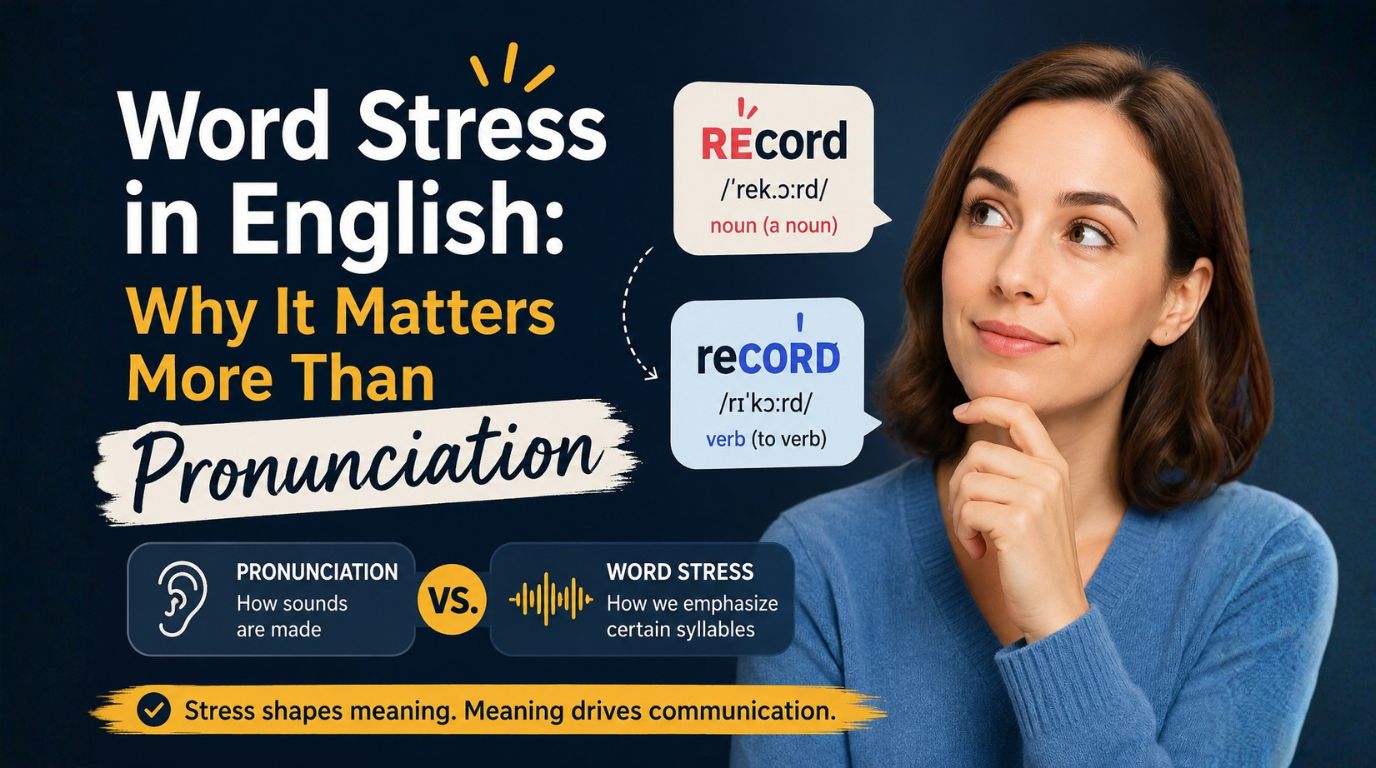
Many English learners spend years trying to perfect individual sounds. They worry about the difference between r and l, the th sound, or whether a vowel sounds fully native. While clear pronunciation does matter, there is another skill that often has a greater impact on how understandable your English sounds: word stress. If stress is wrong, even correctly pronounced sounds can be difficult for listeners to process. If stress is right, listeners often understand you easily even when your accent is still noticeable.
That is why word stress deserves much more attention than it usually receives. English is a stress-timed language, which means rhythm and emphasis play a central role in communication. Learners who want to improve not just isolated sounds but their overall speaking clarity often benefit from exploring a broader set of pronunciation tools and accent practice options in the Accent Help accent resource library, where stress, rhythm, and natural speech patterns can be studied alongside pronunciation.
What Is Word Stress in English?
Word stress is the emphasis placed on one syllable in a word. In English, stressed syllables are usually longer, louder, and clearer than unstressed syllables. This means that a word is not pronounced as a flat string of equally strong sounds. Instead, one part of the word stands out and gives it shape.
For example, in the word TAble, the first syllable is stressed. In beGIN, the second syllable is stressed. Native speakers rely on these patterns automatically when speaking and listening. If the stress falls on the wrong syllable, the word may sound unfamiliar even if each sound is technically correct.
Why Word Stress Often Matters More Than Perfect Pronunciation
Listeners do not decode speech one sound at a time with perfect precision. In real conversation, they process chunks of sound quickly and use rhythm, stress, and expectation to recognize words. That means the overall stress pattern often helps the listener identify a word faster than the exact quality of every consonant and vowel.
A speaker may pronounce every vowel carefully but still confuse the listener if the wrong syllable is stressed. On the other hand, a speaker with a strong foreign accent may still be easy to understand if the word stress is natural. This is one of the main reasons some learners sound “clear” before they sound “native.” Clarity depends heavily on stress placement.
In practical terms, wrong stress interferes with recognition. Right stress supports recognition. That is why improving stress patterns often creates a bigger immediate improvement in intelligibility than trying to remove every trace of an accent.
How Word Stress Changes Meaning
In some English words, changing the stress can even change the grammatical function or meaning of the word. A classic example is REcord versus reCORD. The first is usually a noun, while the second is usually a verb. The same pattern appears in pairs such as PREsent and preSENT, or CONtract and conTRACT.
This is important because listeners use stress as a signal. If you stress the wrong syllable, your listener may hesitate, misunderstand you, or need extra time to figure out what you meant. Even when context eventually fixes the confusion, the conversation becomes less smooth.
Why Stress Matters for Listening as Well as Speaking
Word stress is not only a speaking skill. It is also a listening skill. When learners train themselves to hear stressed syllables clearly, they begin to segment spoken English more accurately. Fast speech becomes easier to follow because the rhythm starts to make sense. Instead of hearing a blur of sounds, they hear a pattern of strong and weak syllables.
This is one reason pronunciation training should not focus only on sound correction. Stress and rhythm improve both production and comprehension. Learners who want to go deeper into these broader speech patterns can also browse other Accent Help pronunciation articles and accent learning guides, where related topics like rhythm, clarity, and natural phrasing can support the same goal.
Common Mistakes Learners Make with Word Stress
One common mistake is treating every syllable equally. This creates speech that sounds careful but unnatural, and it makes it harder for listeners to recognize familiar words quickly. Another mistake is learning vocabulary only from reading, without hearing how the word is stressed in real speech. In that case, a learner may know a word well on paper but still say it in a way that sounds unfamiliar aloud.
A third mistake is focusing too narrowly on single sounds. Learners may spend a great deal of time repeating one difficult consonant while ignoring the larger rhythm of the word. That effort is not wasted, but it is often misplaced. If the goal is better communication, stress usually deserves earlier and more consistent practice.
How to Practice Word Stress Effectively
A strong practice method is to learn new vocabulary together with its stress pattern. Do not memorize only spelling and meaning. Memorize where the energy goes. You can mark the stressed syllable in your notes, say the word aloud in short phrases, and compare it with similar words that follow the same pattern.
It also helps to practice with contrast. For example, pair a noun and verb form together: REcord and reCORD, INcrease and inCREASE. This makes the stress difference more noticeable. Repetition becomes more effective when your ear is trained to notice which syllable carries the main emphasis.
Shadowing is another useful strategy. Listen to a short phrase from a fluent speaker and repeat it immediately, copying not just the sounds but also the rhythm and syllable strength. Over time, this builds a more natural instinct for where English places emphasis.
Key takeaway: If you can only prioritize one pronunciation upgrade for better clarity, choose word stress before chasing perfect accent reduction.
Word Stress and Confidence in Conversation
Correct word stress does more than improve intelligibility. It also increases confidence. When learners know that the rhythm of their words sounds natural, they hesitate less and speak more smoothly. They spend less mental energy monitoring every sound and more energy focusing on meaning, interaction, and fluency.
That shift matters because real communication is not a pronunciation exam. It is a live exchange of ideas. The more your speech follows recognizable English stress patterns, the easier it becomes for listeners to stay with you, and the easier it becomes for you to stay engaged in the conversation.
Final Thoughts
Word stress in English matters more than many learners realize. Perfect pronunciation at the sound level is helpful, but it is not always what determines whether speech is easy to understand. Stress gives English words their recognizable rhythm, guides listeners toward meaning, and supports both speaking and listening.
If you want your English to sound clearer, more natural, and easier to follow, word stress should be one of your first priorities. Once you begin hearing and producing stress patterns more accurately, the rest of pronunciation training becomes more effective because it is built on a stronger rhythmic foundation.