Tu vs. Tú: How the Accent Changes Meaning in Spanish
Few Spanish grammar questions are as common as the difference between tu and tú. They look almost identical, they sound the same in speech, and yet one small accent mark changes the word’s grammatical role completely. For beginners, that can feel frustrating. For fluent readers and writers, it is simply one of the clearest examples of how Spanish accent marks help distinguish meaning.
The good news is that this is one of the easiest accent-mark rules to master once you understand the logic behind it. If you are already practicing Spanish pronunciation and rhythm, it can also help to reinforce the broader sound system with Accent Help’s Spanish accent generator, which is designed to convert plain English text into Spanish-style phrasing for listening and practice. Tools like that are especially useful when you want grammar and sound to support each other rather than feeling like separate study tracks.
The Short Answer: What Is the Difference Between tu and tú?
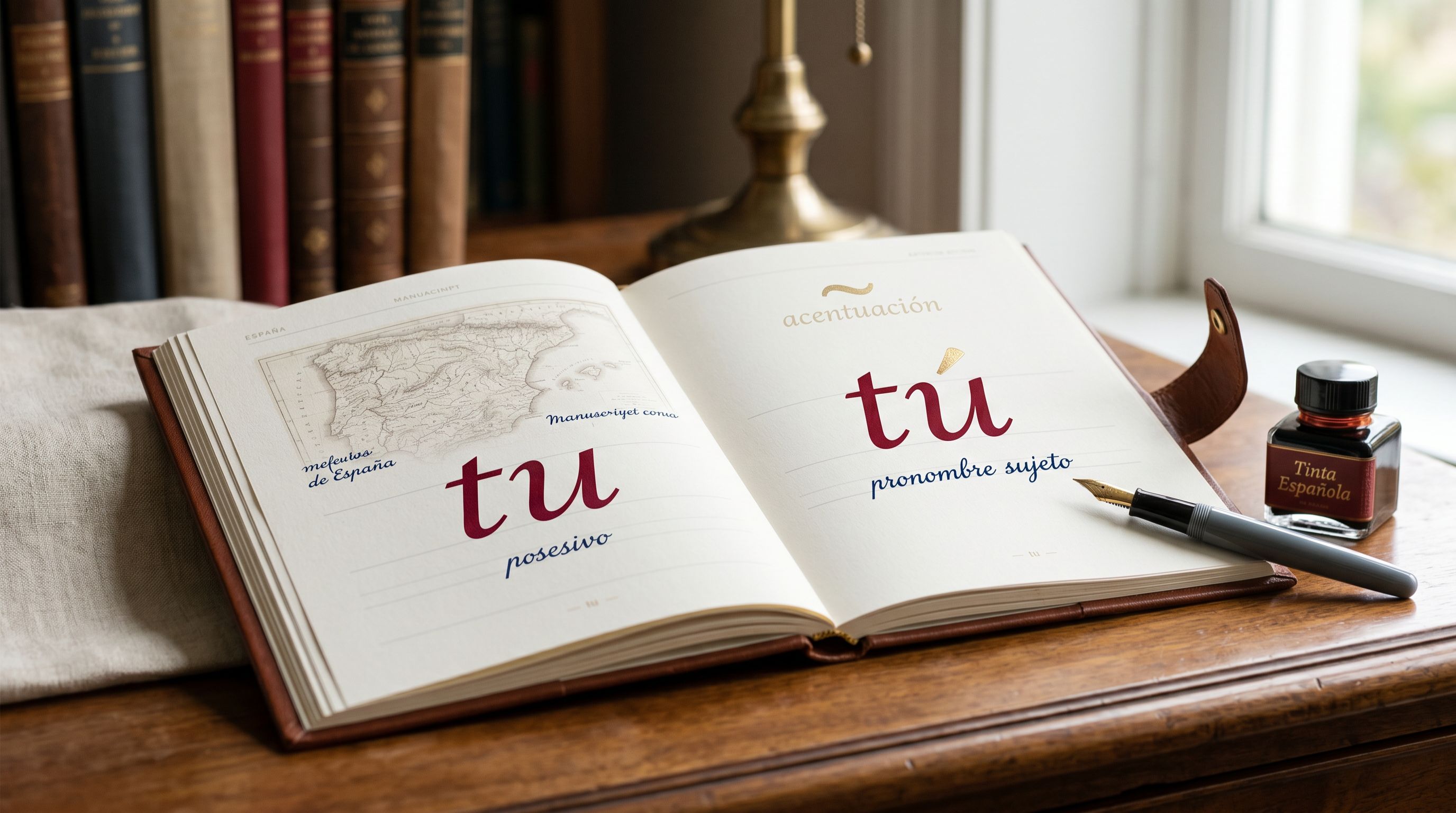
The difference is grammatical, not phonetic. Tú with an accent is a subject pronoun that means you in the singular informal sense. Tu without an accent is a possessive adjective that means your. In other words, tú names the person doing the action, while tu shows possession.
How tú Works in a Sentence
Tú is a personal pronoun. That means it functions as the subject of a sentence, just like I, he, she, or we in English. It refers directly to the person being addressed.
Examples:
- Tú eres inteligente. — You are intelligent.
- Tú tienes un perro negro. — You have a black dog.
- Tú estás aquí. — You are here.
Notice that tú stands independently. It is not attached to another noun. It identifies the person doing or experiencing the action. In many Spanish sentences, the subject pronoun may be omitted because the verb ending already tells you who the subject is, but when the word does appear, the accent matters.
How tu Works in a Sentence
Tu without an accent is a possessive adjective. It describes a noun and means your. Because it is possessive, it always appears next to a noun or noun phrase.
Examples:
- Soy tu madre. — I am your mother.
- María habla con tu amigo. — María talks with your friend.
- Tu casa es hermosa. — Your house is beautiful.
Here, tu does not replace a person. It modifies a noun. If there is no noun after it, then it is probably not the possessive adjective tu.
Why the Accent Mark Matters
Spanish accent marks do more than show stress. They also help distinguish words that are spelled alike but mean different things. This is one of the clearest beginner examples of what Spanish learners call the diacritical accent: an accent mark used to separate two otherwise identical words with different grammatical functions.
That means the accent in tú is not there to make the word sound different from tu. In normal pronunciation, they sound the same. The accent exists to help the reader understand which meaning is intended. This is the same principle behind other Spanish word pairs such as mi versus mí and el versus él.
Key insight: In Spanish, some accent marks are not primarily about pronunciation changes. They are there to prevent ambiguity in writing. That is exactly what happens with tu and tú.
A Quick Test to Know Which One You Need
If you are unsure whether to write tu or tú, use this simple test:
- If the word means you, use tú with an accent.
- If the word means your, use tu without an accent.
You can also check what comes next. If a noun follows immediately, that is a strong sign you need tu. If a verb follows, you probably need tú.
Examples:
- Tú hablas español. — A verb follows, so it means you.
- Tu profesor habla español. — A noun follows, so it means your.
How This Fits Into Spanish Accent-Mark Rules
Spanish accent marks usually help you identify which syllable is stressed. For example, words like teléfono or sofá need an accent because the written mark shows where the emphasis goes. But with short words like tu and tú, the purpose is slightly different. The accent mark is there to distinguish meaning, not to indicate a different spoken stress pattern.
This is why a grammar question like tu vs. tú is also relevant to pronunciation learners. Once you understand that some accent marks carry grammatical information, you stop treating them as random spelling details and start seeing them as part of the language’s precision system. If you want to hear how Spanish rhythm and written stress interact more broadly, using a Spanish pronunciation and phrasing tool can make these rules feel more intuitive in context.
Common Mistakes Learners Make
The most common mistake is assuming that the accent is optional because the words sound the same. In careful written Spanish, it is not optional. Another frequent mistake is trying to memorize the distinction visually without connecting it to grammar. That often leads to hesitation during writing.
A much better approach is to memorize each word by function:
- tú = pronoun = you
- tu = possessive adjective = your
Once you attach each spelling to its grammatical job, the accent mark becomes much easier to remember. This is especially true if you practice with full sentences instead of isolated word pairs.
A Good Practice Method
One effective method is to practice with pairs of sentences that force you to switch between the two forms naturally:
- Tú quieres tu libro. — You want your book.
- Tú cuidas tu casa. — You take care of your house.
- Tú conoces a tu profesor. — You know your teacher.
These examples are useful because they show both words side by side. Once you see them together often enough, the distinction becomes automatic. And if you want to reinforce sentence flow and natural Spanish-style phrasing at the same time, the Spanish accent generator for phrase practice is a helpful companion resource.
How This Connects to Broader Accent Learning
Even though tu versus tú is fundamentally a grammar and orthography topic, it still belongs inside a larger conversation about Spanish language accuracy. Accent marks, sentence stress, and natural phrasing all work together. Learners who want to expand beyond this single rule can explore the full Accent Help accent directory to compare different language and accent resources, or continue with the Spanish accent generator for more focused Spanish-style listening and writing practice.
Final Thoughts
The difference between tu and tú is simple once you see the grammar clearly: tú means you, and tu means your. The accent mark is not decorative. It is the written signal that separates a subject pronoun from a possessive adjective. That one tiny mark gives the reader exactly the information needed to interpret the sentence correctly.
If you want to keep building on this foundation, combining grammar study with listening practice is one of the smartest ways forward. A good next step is to use Accent Help’s Spanish accent practice tool and browse the wider Accent Help accent library so that written rules, sentence stress, and natural phrasing reinforce each other from the very beginning.