The TH Sound: Voiced vs Voiceless (With Drills)
The TH Sound: Voiced vs Voiceless (With Drills)
The English TH sound creates more trouble for learners than almost any other consonant pair. That is not because it is rare in English, but because it asks the tongue to do something many other languages do not ask for very often: lightly touch or come between the teeth while air continues to move. Once you add the fact that English has two TH sounds instead of one, confusion becomes almost inevitable.
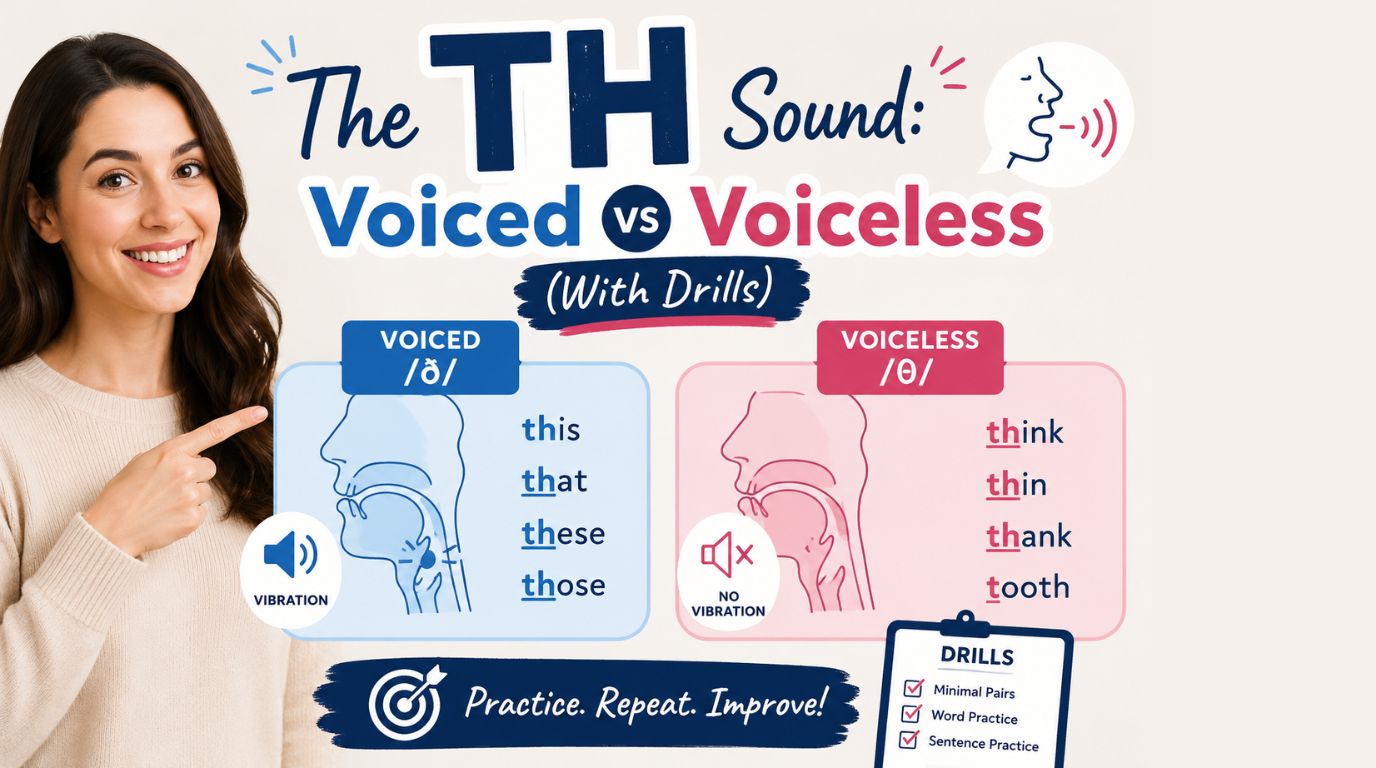
The good news is that the difference between the two sounds is simpler than it first appears. English has a voiceless TH, written in IPA as /θ/, as in think, thumb, and bath, and a voiced TH, written as /ð/, as in this, those, and breathe. The mouth position is almost the same. The real difference is whether your vocal cords vibrate. That basic contrast is also the one highlighted in the British Council’s phonetic exploration of English consonants, which treats /θ/ and /ð/ as a classic voiceless–voiced pair.
Why the TH Sound Is So Difficult
Many languages do not use dental fricatives at all, so learners naturally replace them with more familiar sounds such as t, d, s, z, f, or v. That is why you may hear substitutions like tink for think, dis for this, or fank you for thank you. These substitutions are common, but they matter because TH appears in extremely high-frequency words such as the, this, that, think, three, and with. If the sound is unstable, it affects a very large portion of your everyday English.
This is also why focused consonant training works best when it sits inside a broader pronunciation strategy. If you want to connect individual sound work to phrase-level fluency, Accent Help’s guide to the shadowing technique for English pronunciation is worth pairing with TH drills, because it trains rhythm, stress, and connected speech at the same time instead of isolating every sound forever.
The Mouth Position for Both TH Sounds
For both /θ/ and /ð/, place the tip of the tongue lightly against the upper teeth or let it come just slightly between the teeth. Do not clamp down hard. The tongue should stay relaxed enough to let air pass across it. If you press too tightly, the sound will stop being a fricative and start sounding more like t or d. If the tongue stays too far back, the sound often shifts toward s or z.
This is where physical setup matters. In practical accent training, speech sounds become much easier when the mouth has a consistent “home.” That is exactly the idea behind Accent Help’s explanation of accent placement, which describes placement as the overall oral posture and resonance focus that supports accurate sound production. TH is a perfect example: if your tongue habitually lives too far back, you will fight the sound over and over.
Voiceless TH /θ/: The Air Sound
The voiceless TH /θ/ is produced with airflow only. Your tongue is in TH position, but your vocal cords do not vibrate. You should feel air moving across the tongue and teeth, almost like a softer version of f but with the tongue involved instead of the lower lip. Good starter words include think, thank, thumb, bath, method, and author.
A quick self-check is to place your fingers lightly on your throat while saying think. If you feel no buzz in the throat during the TH, that is correct. If you feel vibration, you are drifting toward the voiced sound instead.
Voiceless TH word drill
think · thank · thin · thumb · thorn · thief · three · through · bath · both · teeth · method
Voiceless TH phrase drill
three thin threads · thank them later · think before you speak · both teeth hurt · throw the thing there
Voiced TH /ð/: The Buzzing Sound
The voiced TH /ð/ uses nearly the same tongue position, but now the vocal cords vibrate. This is the sound in this, that, these, those, there, and in many function words that appear constantly in natural English. Because these words occur so often, stabilizing voiced TH can improve how natural your English sounds very quickly.
To check the sound, keep your fingers on your throat and say this. You should feel vibration during the TH. If you do not, you are probably using /θ/ instead of /ð/. If the tongue stays too far behind the teeth, the sound may become d or z.
Voiced TH word drill
this · that · these · those · though · they · them · there · other · mother · brother · breathe
Voiced TH phrase drill
this and that · those are theirs · they know them · the other brother · breathe with rhythm
Minimal Pairs: The Best Way to Feel the Contrast
Minimal-pair practice is one of the quickest ways to sharpen both hearing and production. The goal is to keep everything the same except the target consonant. Here are a few helpful contrasts:
- thin vs. then
- thigh vs. thy
- ether vs. either
- mouth (noun) vs. mouth (verb)
- breath vs. breathe
The last two pairs are especially useful because they show how voicing can change meaning even when spelling looks almost identical. If you tend to confuse spelling and pronunciation more generally, Accent Help’s article on words commonly mispronounced in English is a useful companion read, since English often hides pronunciation traps in otherwise familiar-looking spellings.
A Daily Drill Routine That Actually Works
Most learners improve faster with short, repeatable drills than with occasional long pronunciation sessions. A practical TH routine can be done in ten minutes:
- Spend one minute switching silently between TH mouth position and normal resting position.
- Read six voiceless TH words slowly, then six voiced TH words slowly.
- Use your hand on your throat to confirm voicing.
- Read one set of minimal pairs three times each.
- Say two short phrases at conversational speed.
- Finish by shadowing one sentence from a clear speaker.
That final step matters. TH almost never lives in isolation during real speech. It lives inside connected phrases such as the other thing, thank you, and this is the one. Using the shadowing method for pronunciation practice helps turn the correct TH from a drill sound into a real conversation sound.
Simple rule: if the TH appears in very common grammar words such as the, this, that, these, and those, it is usually voiced. If it appears in many content words such as think, thank, thin, and three, it is often voiceless.
Accent Background Matters
The substitutions you make often depend on your first language or accent background. Spanish-speaking learners may replace TH with t, d, or s depending on context, which is one reason Accent Help’s Spanish accent generator can be a useful comparison tool when you want to notice how Spanish-influenced English phrasing differs from mainstream English consonant habits. Learners working toward a UK target may also want to compare line shape and cadence with the British accent generator, especially because TH appears in many very common British-function-word patterns that you want to keep fluid, not over-pronounced.
For broader comparison, the full Accent Help accent directory is useful because it lets you compare regional speech styles without assuming that every TH variation is an error. Some local accents reduce or substitute TH in certain environments, but if your goal is clear mainstream international English, it still makes sense to master /θ/ and /ð/ in their standard forms first.
Common TH Mistakes and Fast Fixes
If TH sounds like T or D: move the tongue farther forward so it actually touches or peeks between the teeth.
If TH sounds like F or V: check that the tongue, not the lower lip, is creating the friction.
If TH sounds like S or Z: the tongue is probably too far back behind the teeth.
If voiced and voiceless TH keep blending together: go back to the throat-touch test and exaggerate the buzz difference for a few days before reducing it to normal speech.
Final Thoughts
The two TH sounds are easier to master once you stop treating them as mysterious spelling problems and start treating them as a simple voicing contrast built on one shared mouth position. Keep the tongue light, keep the airflow steady, and let voicing do the rest. Practice the pair in words, then in phrases, then in connected speech.
If you want to keep improving beyond isolated drills, combine your TH practice with placement work that stabilizes mouth posture, use shadowing to make the sound automatic in real speech, and explore Accent Help’s wider library of accent resources if you want to understand how the TH sound behaves across different speech targets and learner backgrounds.