Midwestern Slang: What It Means, Where It Comes From, and How to Use It Naturally
Midwestern slang has a reputation for sounding friendly, practical, and a little understated, which is exactly why it can be harder to define than more theatrical regional speech. Unlike slang that announces itself loudly, Midwestern expressions often slide into everyday conversation so naturally that native speakers may not even realize they are using regionally marked language. That is part of what makes Midwestern slang so interesting: it is not just a word list, but a tone of communication built on modesty, warmth, and local habit.
If you want to understand how Midwestern slang actually works, it helps to pair vocabulary with voice. The Midwestern accent generator from Accent Help is especially useful because it shows how broad Midwestern speech stays subtle, readable, and neighborly rather than heavily stylized. That is important context, because many Midwestern sayings do not land through dramatic spelling changes. They land through tone, timing, and familiar phrasing.
What Counts as Midwestern Slang?
Midwestern slang includes words, expressions, fillers, and conversational habits associated with the American Midwest. Some are clearly lexical, like pop for a soft drink or hotdish in Minnesota. Others are more about social rhythm, such as the famous “Midwestern goodbye” or filler words like ope. The challenge is that the Midwest is huge, and its language is not uniform. Broad Midwestern English is best understood as a family of related speech patterns rather than a single accent or a single slang system.
That variation matters. A phrase common in Minnesota may sound unfamiliar in Illinois, while Chicago vocabulary may feel too urban and place-specific to stand in for the region as a whole. That is why it helps to compare the broader Midwestern speech guide with more local tools such as the Chicago accent generator and the Minnesotan accent generator. Each one highlights a different layer of regional identity.
Common Midwestern Slang Words and Phrases
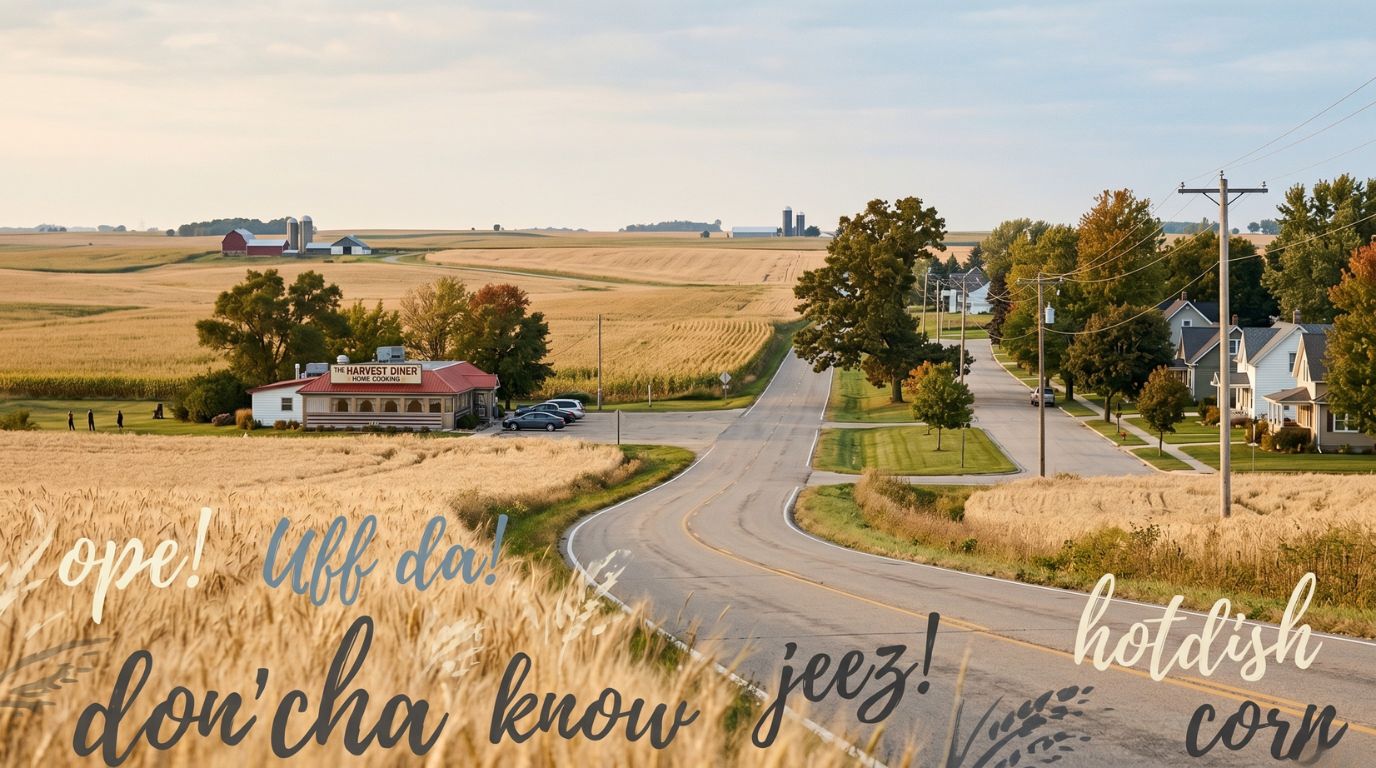
Some Midwestern expressions have become almost symbolic of the region. The best-known example is ope, a quick exclamation used as a mild apology, a reaction to surprise, or a polite way to squeeze past someone. It is the kind of word that often appears in tiny everyday moments: bumping a shopping cart, stepping in front of someone at the store, or reaching across a table. It feels casual, automatic, and deeply regional precisely because it is so unforced.
Another classic phrase is you betcha, which functions as a cheerful, affirming way to say yes. In broader Midwestern-style writing, lighter markers such as you bet, real quick, and pretty good help create an approachable, sincere voice without overdoing the region. Accent Help’s broad Midwestern accent tool specifically notes that this kind of understated warmth is one of the region’s defining strengths.
Vocabulary terms matter too. In much of the Midwest, a soft drink is called pop, though that is not universal even within the region. In Minnesota, hotdish is a familiar food term with strong regional identity. In parts of Wisconsin, bubbler means water fountain. In Michigan, Yooper refers to someone from the Upper Peninsula. These examples show why Midwestern slang is better thought of as a cluster of overlapping local systems rather than a neat master list.
The Social Style Behind Midwestern Slang
What makes Midwestern slang feel distinct is not just the words themselves, but the social style they carry. Midwestern speech is often described as polite, practical, modest, and lightly humorous. That means slang is often softened rather than performed. The same region that gives you ope also gives you understatement, hedging, and a tendency to avoid sounding flashy. In Accent Help’s framing, good Midwestern-style writing sounds grounded and sincere rather than loud or overworked.
This also helps explain cultural phrases like the “Midwestern goodbye,” which is less a literal sentence than a familiar social ritual. It refers to the long, staged process of leaving a gathering: standing up, chatting at the door, continuing the conversation outside, then somehow extending the farewell again. It is slang in the cultural sense rather than a dictionary sense, and it captures the region’s emphasis on friendliness and social courtesy.
Practical takeaway: If you want Midwestern slang to sound real, do not just collect words. Pay attention to the tone they sit inside — polite, low-pressure, and often slightly self-deprecating.
Broad Midwest vs. Local Midwest: Why It Matters
One of the easiest mistakes to make is treating “Midwestern” as if it means the same thing everywhere from Ohio to Minnesota. It does not. Chicago speech, for example, carries a much stronger urban identity and more place-tied vocabulary than broad Midwestern speech. Words like the L, dibs, and over by can make a line feel immediately Chicago, while broader Midwestern voice stays more nationally readable and less tied to city-specific references.
The same is true in the Upper Midwest. Minnesota and nearby areas often carry stronger regional coloring than neutral Midwestern speech. If you want to hear that difference more clearly, the Minnesotan accent guide is useful because it pushes farther into Upper Midwest flavor, while the broader Midwestern accent page stays closer to the region’s softer, more general voice.
So if you are writing, performing, or studying Midwestern slang, the most professional approach is not to ask, “What do Midwesterners say?” but rather, “Which part of the Midwest am I trying to sound like?” That question leads to much more accurate choices.
How to Use Midwestern Slang Naturally
The best way to use Midwestern slang naturally is to use less of it than you think you need. Broad Midwestern writing works best when the voice feels steady, readable, and lightly regional. Accent Help explicitly warns against forcing too much slang or leaning too hard on phonetic spellings, because that usually makes the result feel less Midwestern, not more. A few carefully chosen markers such as ope, you bet, or real quick can be enough to establish place.
Context matters just as much as vocabulary. A Chicago character might naturally say pop or reference the L, while a Minnesota-coded voice might lean into terms like hotdish or other Upper Midwest cues. If the setting is broad suburban or small-town Midwest, however, over-specific markers can feel misplaced. That is why it is helpful to move between the Chicago accent resource, the Minnesotan accent resource, and the general Midwestern voice tool to hear how each layer of regional identity shifts the tone.
Midwestern Slang Examples in Context
Here are a few examples of how Midwestern slang works best in context rather than as isolated decoration:
- “Ope, sorry — lemme squeeze right past ya.” This sounds more natural than simply dropping ope into a sentence for effect.
- “You bet, that sounds pretty good to me.” The warmth comes from the phrase as a whole, not just the regional marker.
- “Can you bring some pop for the game tonight?” One local noun instantly shifts the scene into a Midwestern register.
- “We’re doing hotdish after church.” This is stronger and more localized, especially in Minnesota contexts.
What these examples show is that the most convincing Midwestern slang usually arrives in modest doses. You do not need every sentence to carry a regionally marked word. In fact, you usually should not.
Why Midwestern Slang Still Matters
Midwestern slang matters because it reflects how regional identity survives even in varieties of American English that are often treated as “neutral.” Broadcast-style American speech has historically overlapped with broadly Midwestern patterns, which can make the region sound less marked to outsiders than it really is. But once you listen closely, the Midwest reveals its own vocabulary, politeness strategies, and conversational rhythms.
This is also why Midwestern slang is so useful for writers, actors, and content creators. It can signal place without becoming inaccessible. The region’s language is often subtle enough to stay widely readable while still feeling specific, which makes it especially valuable for dialogue, commercials, family scenes, and character work that aims for warmth rather than caricature.
Final Thoughts
Midwestern slang is not just a collection of quirky sayings. It is a regional communication style shaped by understatement, friendliness, local vocabulary, and a deep preference for sounding natural rather than performative. Some terms, like ope and you betcha, are widely recognized across the region. Others, like hotdish, dibs, or bubbler, are more local and reveal exactly why the Midwest should never be treated as one flat speech zone.
If you want to keep exploring how Midwestern slang interacts with actual regional voice, the best next step is to compare the Midwestern accent generator with the more local Chicago accent guide, the Minnesotan accent guide, and the wider Accent Help directory of regional accent tools. Hearing the differences is often the fastest way to understand why Midwestern slang feels so familiar, specific, and quietly distinctive.