Long and Short Vowel Sounds List: Clear English Examples for Learners
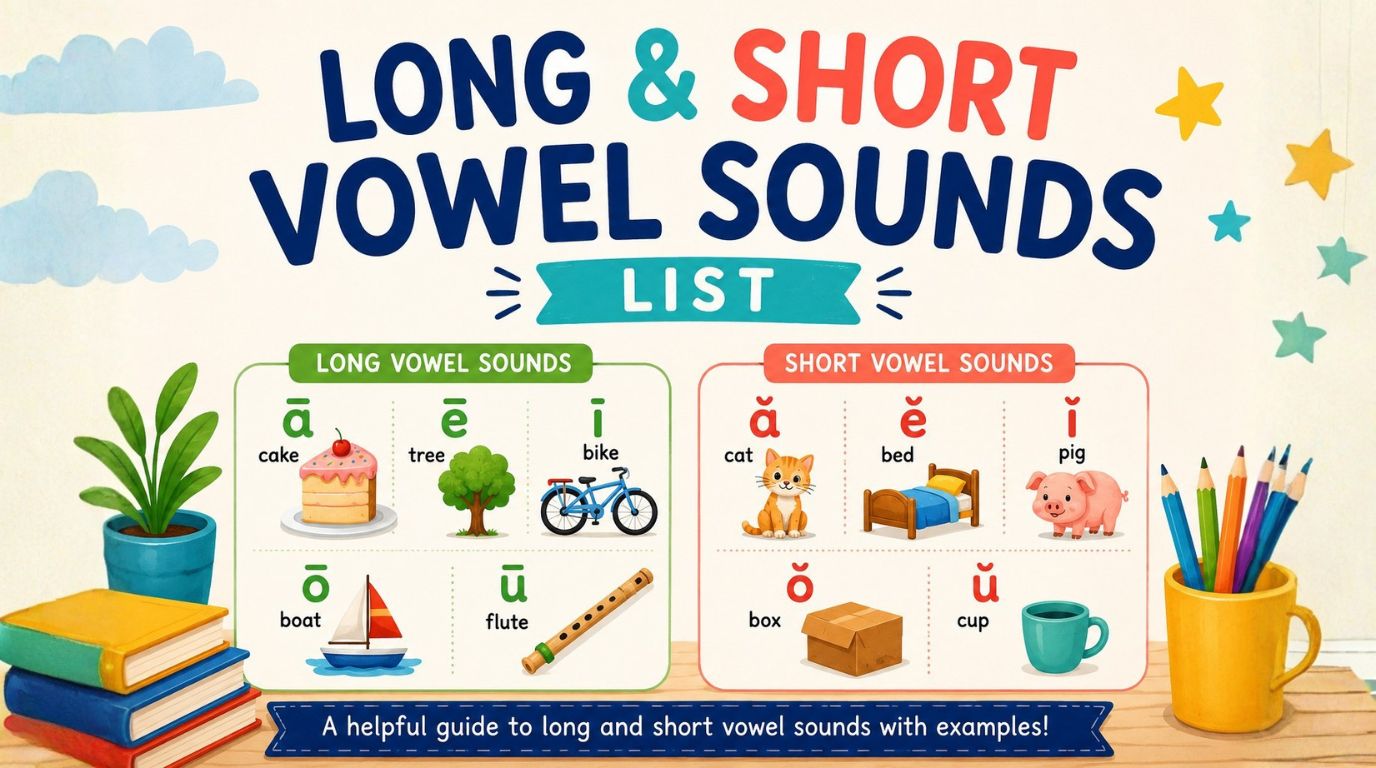
Learning the long and short vowel sounds list is one of the fastest ways to improve English pronunciation. Many learners can read basic words, but they still feel unsure about why bit sounds different from bite, or why hop and hope do not use the same vowel. Once you understand how English vowel length and quality work, your speech becomes clearer, your listening improves, and spelling patterns start to make more sense.
This guide gives you a practical long and short vowel sounds list with examples, spelling clues, and simple memory strategies. If you want to keep developing your broader pronunciation skills after this lesson, you can also explore the full accent resource directory for pronunciation and dialect study or browse the Accent Help blog archive with more speech and pronunciation articles for related practice.
What Are Long and Short Vowel Sounds?
In beginner English teaching, short vowels usually refer to the simpler vowel sounds heard in words like cat, bed, sit, hot, and cup. Long vowels usually refer to vowels that sound like the letter names: A in cake, E in see, I in time, O in home, and U in music or rule, depending on the word.
The terms “long” and “short” are useful for learners, but they are a simplification. In real pronunciation, the difference is not only about duration. It is also about mouth shape, tongue position, and sound quality. Even so, the long-versus-short framework is still a very effective starting point for students, teachers, actors, and anyone working on clearer English speech.
The Full Long and Short Vowel Sounds List
Here is a practical list of the five main short vowel sounds and the five main long vowel sounds most learners study first.
Short Vowel Sounds with Examples
Short vowels usually appear in one-syllable words with a consonant-vowel-consonant pattern, though English always has exceptions. These are the core short vowel sounds most learners study first:
- /æ/ as in cat, bag, lamp
- /ɛ/ as in bed, ten, dress
- /ɪ/ as in sit, milk, fish
- /ɒ/ or a similar open back vowel in many accents, as in hot, rock, not
- /ʌ/ as in cup, luck, run
These sounds are foundational because they appear in many high-frequency English words. If a learner confuses short vowels, basic communication can become less clear. For example, mixing ship and sheep or full and fool can change meaning immediately.
Long Vowel Sounds with Examples
Long vowels are often introduced as vowels that say their own names. This is not a perfect scientific definition, but it works well for practical learning. Here are the main long vowel sounds:
- /eɪ/ as in cake, late, train
- /iː/ as in see, eat, field
- /aɪ/ as in time, my, light
- /oʊ/ as in home, boat, show
- /juː/ or /uː/ as in music, student, blue, true
Notice that long vowels are often created by several spelling patterns, not just one. That is why English spelling feels difficult at first. The sound /iː/, for example, can appear in see, seat, machine, and people, even though the spellings are different.
Key insight: In English, the same vowel letter can represent multiple sounds, and the same sound can be spelled in multiple ways. That is why learners need both sound recognition and word-based practice.
Common Spelling Patterns for Long Vowels
Although English is not fully predictable, some spelling patterns appear again and again. Learning them helps you guess pronunciation more accurately.
- Silent e: cap becomes cape, sit becomes site, hop becomes hope
- Vowel teams: rain, team, boat, day
- Open syllables: me, go, hi
- Final y: my, baby, try
These patterns are especially helpful in reading instruction, but they are also useful for adult learners improving accent clarity. If you are working more broadly on sound systems across English varieties, the collection of regional accent guides and pronunciation tools can help you compare how vowel quality changes across accents, while the pronunciation article library offers related explanations on speech patterns and sound training.
Minimal Pairs: The Best Way to Hear the Difference
One of the most effective ways to practice long and short vowels is with minimal pairs. These are pairs of words that differ by only one sound. They train your ears and your mouth at the same time.
- bit / beat
- full / fool
- hat / hate
- hop / hope
- cut / cute
When you practice these pairs, do not rush. Say each word slowly, exaggerate the contrast, and notice how your lips, jaw, and tongue move. Clear pronunciation often improves faster when learners stop thinking only about letters and start focusing on physical speech habits.
Why Vowel Sounds Matter So Much in English
English consonants matter, but vowels carry a huge amount of meaning. Many common misunderstandings happen because the vowel was too short, too tense, too central, or too open. This is especially important for learners whose first language has a smaller vowel system than English. In that case, several English vowel sounds may feel like the same sound at first, even though native listeners hear them as clearly different categories.
Vowels also change noticeably across accents. A vowel in American English may not match the exact quality of the same word in British, Australian, Irish, or regional North American speech. That does not mean one version is wrong. It means learners should aim for consistency within the accent they want to develop. If that broader topic interests you, browsing the Accent Help accent comparison pages can give useful context for how vowel patterns shift between dialects.
Common Mistakes Learners Make
A very common mistake is assuming that long vowels are simply the same as short vowels but held longer. In reality, they often use a different mouth shape and a different sound target. Another common mistake is trusting spelling too much. English spelling gives clues, but it does not guarantee pronunciation.
Learners also sometimes practice vowels in isolated words but never in full sentences. That can slow progress, because real speech adds stress, rhythm, and connected pronunciation. For this reason, it helps to combine word lists with sentence drills and listening repetition.
A Practical Way to Study the Long and Short Vowel Sounds List
A strong daily practice routine does not need to be complicated. Start by choosing one short vowel and one long vowel that learners often confuse, such as /ɪ/ and /iː/. Listen to examples, repeat minimal pairs, then place those words into short sentences. Record yourself and compare what you hear.
- Read five example words aloud for one target sound.
- Practice three minimal pairs slowly and clearly.
- Use each target word in a short sentence.
- Record yourself and listen for consistency.
- Repeat the same contrast for several days before switching.
Learners who stay consistent with this kind of focused repetition usually improve more quickly than learners who jump randomly from one pronunciation topic to another. If you want more training ideas after this article, the Accent Help blog’s pronunciation practice section is a good next place to continue.
Final Thoughts
The long and short vowel sounds list gives you a practical foundation for clearer English. At the most basic level, short vowels include sounds like cat, bed, sit, hot, and cup, while long vowels include sounds like cake, see, time, home, and music or blue. Once you can hear those patterns clearly, reading, speaking, and listening all become easier.
The most important thing is not memorizing a chart once, but practicing the sounds repeatedly in real words and sentences. With steady listening and speaking practice, these vowel contrasts start to feel natural. From there, you can keep expanding into rhythm, stress, and regional pronunciation by exploring the wider library of accent and speech resources and reading more in the Accent Help pronunciation blog.