British Isles Accent Map: A Practical Guide to UK and Irish Voices
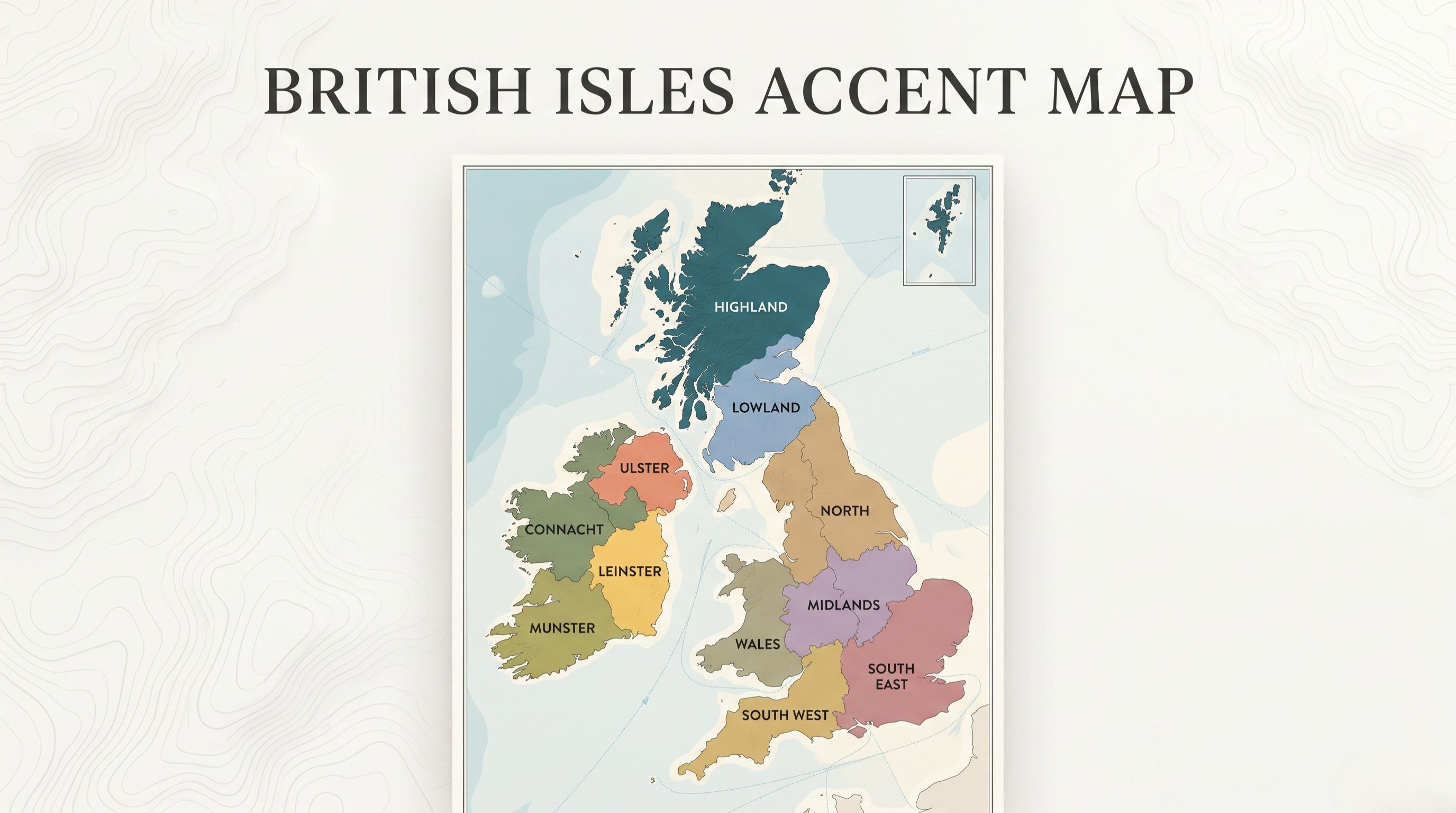
If you have ever searched for a British Isles accent map, you were probably hoping for a simple answer to a complicated question. The truth is that there is no single “British accent.” Instead, the British Isles contain a wide range of regional accents and dialects shaped by geography, identity, migration, class, and history.
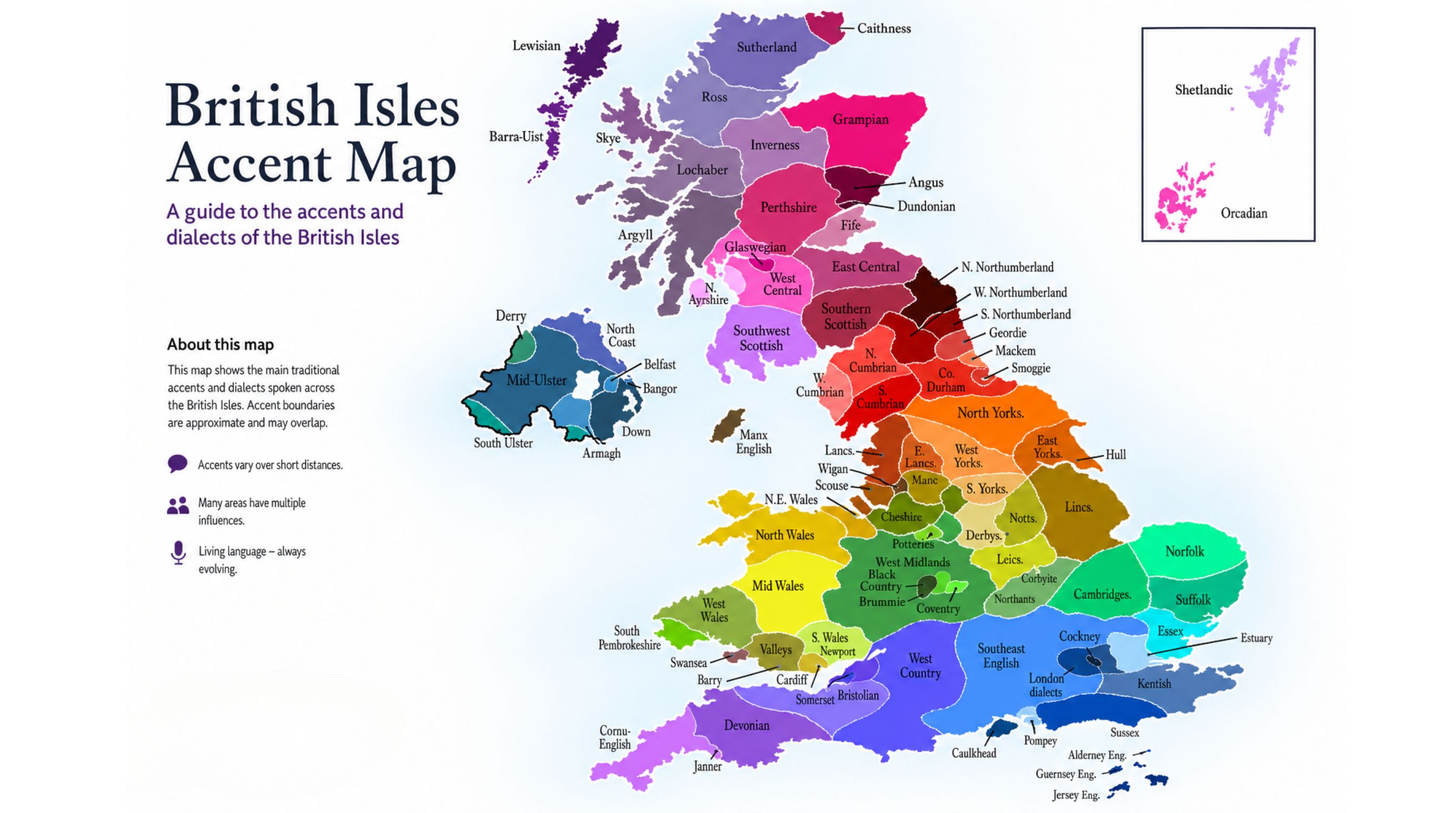
This guide gives you a practical way to understand the main accent zones across England, Scotland, Wales, Northern Ireland, and Ireland, while also showing why accent boundaries are never as neat as the lines on a map.
What an Accent Map Can Actually Show
An accent map is best used as a learning shortcut, not as a perfect linguistic border chart. It helps you identify broad regions, typical sound patterns, and major accent families. But real speech changes gradually from town to town, city to suburb, and generation to generation.
That means a useful map should do two things at once: show the main regional groupings, and remind you that real-life accents blend, overlap, and evolve.
Accent vs. Dialect: A Quick Distinction
People often use the words accent and dialect as if they mean the same thing, but they are not identical.
- Accent refers mainly to pronunciation.
- Dialect includes pronunciation, but also vocabulary and grammar.
So when people talk about a “British Isles accent map,” they usually mean pronunciation patterns. In practice, though, many regional speech varieties also differ in wording and sentence structure.
British Isles Accent Map: Main Regions
1. Southern England
Southern England includes several of the most internationally recognized accents. The best-known prestige model is often called Received Pronunciation (RP) or modern Standard Southern British English. It is not tied to one exact town, but it has long been associated with education, broadcasting, and formal speech.
Within and around London, you also hear Cockney, Estuary English, and a wide range of newer urban London accents. These varieties may feature glottal stops, strong vowel shifts, and faster rhythm patterns that learners often find more difficult than formal broadcast speech.
2. The West Country
The West Country, including areas such as Bristol, Somerset, Devon, and Cornwall, is famous for its more rural sound profile. Many listeners associate this region with rhoticity, meaning the r sound is more likely to be pronounced in words like “car” and “farm.”
Even within this area, city speech and rural speech can sound very different, so it is better to think in terms of a family of related accents rather than one single West Country voice.
3. The Midlands
The Midlands are often underestimated on simplified maps, but they contain several highly distinctive accents. Brummie is associated with Birmingham, while the Black Country has its own strong local identity and sound system. Further east and north, Midlands speech begins to overlap with northern patterns.
This is one of the best examples of why accent maps should show transition zones, not just labels.
4. Northern England
Northern England includes some of the most recognizable accents in the English-speaking world. Among the best known are Scouse (Liverpool), Geordie (Newcastle and Tyneside), Yorkshire, Mancunian (Manchester), and varieties from Lancashire, Cumbria, and surrounding areas.
Compared with much of southern England, northern accents often preserve different vowel patterns and may avoid some southern sound changes. Even so, “Northern English” is still far too broad to describe what speakers actually sound like from one place to the next.
5. Wales
Welsh English is shaped by both English and Welsh language history. Depending on the region, Welsh accents may sound more musical or lilting to outside listeners, with distinctive intonation patterns that stand out even when the individual consonants and vowels seem familiar.
North and south Wales do not sound the same, and bilingual communities can add another layer of variation. For learners, Welsh English is a reminder that melody and rhythm matter just as much as individual sounds.
6. Scotland
Scottish English covers a broad range of accents, from urban Glasgow and Edinburgh speech to Highlands and island varieties. Many Scottish accents are more rhotic than southern English accents, and Scottish speech often has very different vowel patterns from what learners first encounter in standard textbook British English.
It is also important to remember that Scotland includes not only Scottish English, but also the Scots language and Gaelic traditions in some communities. Any serious accent map should treat Scotland as diverse, not uniform.
7. Northern Ireland
Northern Ireland has its own rich mix of speech traditions, influenced by Irish English, Ulster Scots, and historical settlement patterns. Accents around Belfast may sound very different from those in Derry/Londonderry or rural Ulster communities.
For learners, Northern Irish speech can be especially interesting because it may share features with both Scottish and Irish patterns, while still sounding clearly local.
8. Ireland
Across Ireland, accents vary widely between Dublin, Cork, Galway, Limerick, and rural regions. Some Irish English accents are light and internationally familiar; others are much more local in rhythm, consonants, and vowel quality.
From a listening perspective, Irish accents are among the most rewarding to study because they combine clarity, musicality, and strong regional identity. A good British Isles accent map should never treat “Irish” as just one accent.
Why Accent Boundaries Are Never Clean
One of the biggest mistakes learners make is assuming that accents stop at county lines or political borders. They do not. Speech usually changes gradually. A village may sound more like the next county than the far side of its own region. Large cities also spread their influence outward, creating broad urban accent zones.
That is why any map should be read as an overview, not a final answer. It is a starting point for listening, comparing, and noticing patterns.
Key Features Learners Can Listen For
If you are using a British Isles accent map to improve comprehension or pronunciation, focus on a few practical features:
- Rhotic vs. non-rhotic speech — is the r pronounced in words like “car” and “hard”?
- T sound variation — do you hear a clear t, a flap, or a glottal stop?
- Vowel shifts — do words like “bath,” “goat,” “face,” or “price” sound different from the version you learned first?
- Intonation — is the speech flatter, more musical, more clipped, or more rising in tone?
- Local vocabulary — are there regional words that signal a local dialect as well as an accent?
How to Use an Accent Map for Practice
The best way to use an accent map is not to memorize labels. Instead, use it to build a listening system:
- Pick one region at a time.
- Listen to several speakers from that region.
- Notice repeated sound patterns.
- Compare nearby regions rather than jumping across the whole map.
- Practice shadowing short clips instead of isolated words only.
This approach helps you hear the difference between broad categories like “Scottish,” “Northern English,” or “Irish,” while also training your ear for finer local detail.
So, Is There One “British Accent”?
No. What many people call a “British accent” is usually one highly visible southern English standard, often based on older broadcast norms. But that is only one voice among many. The British Isles are home to a dense and fascinating network of accents, each carrying social meaning, regional identity, and historical depth.
If you want to sound more natural, understand native media more easily, or recognize where a speaker may be from, a British Isles accent map is a smart place to start.
Final Thoughts
A British Isles accent map is most useful when it helps you listen with more precision. It should not flatten real voices into stereotypes. Instead, it should help you hear the living diversity of speech across England, Scotland, Wales, Northern Ireland, and Ireland.
At AccentHelp, we recommend using maps as orientation tools, then moving quickly into real listening practice. Once you connect each region to real speakers, the map becomes far more than an image — it becomes a guide to how people actually sound.
FAQ
What is the easiest British Isles accent for learners to start with?
Many learners begin with modern standard southern British speech because it is widely represented in teaching materials and media. After that, branching into northern English, Welsh, Scottish, and Irish accents becomes much easier.
Are accent and dialect maps the same thing?
No. Accent maps focus on pronunciation. Dialect maps also include grammar and vocabulary.
Why do some nearby places sound completely different?
Migration, class, industry, education, language contact, and city influence can all reshape local speech. Geography matters, but history matters too.