American vs British Accent: 10 Key Differences (With Examples)
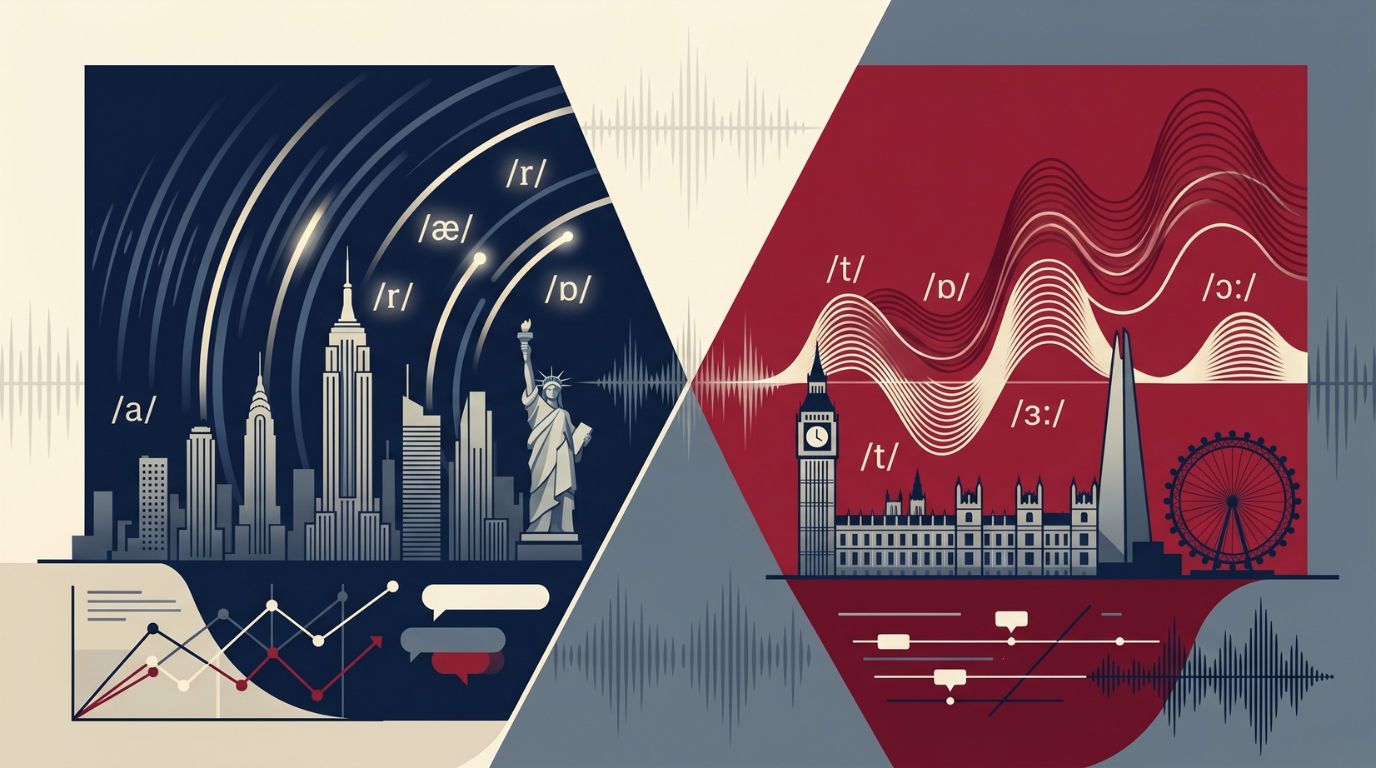
When people compare an American accent with a British accent, they usually imagine two neat categories. In reality, both countries contain many regional and social varieties. Still, for practical learning, comparison usually starts with two broad reference points: a smooth, widely understood U.S. model often described as General American, and a broad southern British or RP-informed model that many learners treat as a default British reference. That is also how Accent Help frames the contrast between its General American accent generator and its British accent generator, which makes them useful anchors for learners, writers, and actors exploring the difference.
Just as important, neither “American” nor “British” is a single voice. Accent Help’s neutral American accent guide explains that General American is best understood as a broadly readable U.S. speech model rather than one exact hometown sound, while its Received Pronunciation history guide shows that prestige British speech was historically taught and institutionalized rather than naturally spoken by all Britons. That perspective matters because it stops this comparison from becoming simplistic and makes the differences below much more useful in practice.
General American
A broadly recognizable U.S. model associated with rhotic r, clear everyday phrasing, and a relatively neutral media-friendly sound. Accent Help describes this style as smooth, neutral American pronunciation with clear everyday delivery, which is why the General American practice tool works well as a baseline for comparison.
Broad British / RP-Informed
A readable UK-style model associated with non-rhotic speech, different vowel choices, and more classically British cadence. Accent Help’s British accent reference page positions this as elegant, understated, and broadly accessible rather than heavily regional.
Quick Comparison Chart: Where the Differences Show Up Most
The fastest way to understand American and British accents is to break them into layers. Some differences are instantly audible, such as the treatment of r or the vowel in bath. Others sit in rhythm, vocabulary, or grammar choices. The chart below is not a scientific measurement, but it is a useful learner-oriented snapshot of where listeners typically notice the contrast first. It aligns well with Accent Help’s internal distinction between a broadly readable British model and a broadly readable American one, and it also matches the general overview in the University of Texas Permian Basin article on British and American English differences.
| Feature Area | American Accent Presence | British Accent Presence | What Listeners Usually Notice |
|---|---|---|---|
| Post-vocalic R | One of the clearest first-pass differences in words like car, teacher, and far. | ||
| Vowel Shifts | Especially noticeable in bath, not, lot, dance, and can’t. | ||
| Treatment of T | American speech often flaps the t in water, while British speech more often keeps a clear t. | ||
| Rhythm & Intonation | British speech may feel more clipped or contrastive to some U.S. listeners; American speech often feels flatter or more even to some UK listeners. | ||
| Vocabulary & Usage | Words like apartment vs flat or vacation vs holiday often reinforce the accent impression. |
The Main Comparison Table: 10 Key Differences With Examples
The table below compares broad American and British reference accents across ten high-value listening and speaking differences. It combines pronunciation, rhythm, vocabulary, and usage because in real life those layers interact. Someone may notice r first, but they often form their overall judgment from several features working together at once.
| # | Feature | American Accent | British Accent | Example | Why It Matters |
|---|---|---|---|---|---|
| 1 | R after vowels | Usually rhotic, so the r is pronounced clearly. | Often non-rhotic in broad southern British models, so the r may disappear before a consonant or pause. | car → American car, British cah | This is often the single fastest way listeners tell the accents apart. |
| 2 | BATH vowel | Usually a shorter vowel in words like bath, class, and dance. | Often a broader “ah” quality in the same words. | bath → American short a, British broad ah | This difference strongly shapes the “feel” of British speech for many learners. |
| 3 | Intervocalic T | Often realized as a flap in everyday speech. | More likely to remain a clear t in broad standard models. | water → American closer to wa-der, British wa-tuh | It changes line rhythm and is very noticeable in casual conversation. |
| 4 | LOT / hot vowel | Often more open and flatter in words like hot and not. | Often rounder or more differentiated depending on the speaker. | hot, not, lot | These small vowel differences add up quickly across whole sentences. |
| 5 | Yod in words like tune | Often drops the y sound in many contexts. | More likely to keep it. | tune → American toon, British tyoon | This affects many high-frequency words such as news, duke, and student. |
| 6 | Stress patterns | Some multi-syllable words place stress differently. | Stress may shift earlier or more sharply in the word. | advertisement, garage, adult | Stress differences can make a speaker sound instantly more American or more British even without huge consonant changes. |
| 7 | Rhythm and pacing | Often feels smoother and more level in broad media speech. | Often feels more contrastive, clipped, or shape-driven to international listeners. | Short conversational lines like “I’ll call you when I arrive.” | Accent perception depends on whole-line flow, not only individual sounds. |
| 8 | Vocabulary choices | Uses U.S.-preferred wording. | Uses UK-preferred wording. | apartment / flat, elevator / lift, vacation / holiday | Vocabulary often reinforces the accent identity even when pronunciation is mild. |
| 9 | Recent-past grammar | Simple past is common in everyday recent action. | Present perfect is often preferred in comparable contexts. | I just ate vs I’ve just eaten | This is not pure accent, but it strongly shapes perceived national style in speech. |
| 10 | Everyday idiomatic phrasing | Tends toward U.S. idioms and direct phrasing. | Tends toward UK idioms and localized phrasing. | call me vs ring me, on the weekend vs at the weekend | Phrase choice can reveal “American” or “British” identity before a listener analyzes the vowels. |
Difference #1: The R Sound Is the Fastest Separator
If you only learn one difference first, make it the r. Broad American speech is usually rhotic, which means speakers pronounce the r clearly in words like car, work, and teacher. Broad southern British speech, especially RP-influenced models, is usually non-rhotic, meaning the r tends to disappear unless a vowel follows. That is why car often sounds closer to cah in British reference speech. Accent Help’s Received Pronunciation explainer and its neutral American accent guide both treat this as a foundational contrast.
Difference #2: The BATH Set Changes the Entire Color of Speech
Words like bath, class, and dance are some of the most famous contrast words between British and American reference accents. In many broad American patterns, the vowel stays shorter and flatter. In many broad British patterns, especially southern ones, it shifts toward a broader “ah” quality. The University of Texas Permian Basin overview highlights this as one of the most audible vowel differences for general listeners, which is why it appears so often in beginner accent lessons.
Difference #3: American Speech Often Flaps the T
American English frequently turns the t in words like water, better, and city into a quick flap between vowels, making it sound closer to a soft d. British reference speech more often keeps a clearly articulated t. This is not universal across all speakers on either side of the Atlantic, but it is common enough to matter in training. If you compare line shape using the General American accent practice page and the British-style phrasing tool, this contrast becomes much easier to hear in short sentences.
Difference #4: Vowels Do More Work Than Most Learners Expect
Many learners think accent is mostly about consonants, but vowels often carry the stronger regional signature. American and British models diverge in the vowels of words like lot, hot, not, thought, go, and face. These differences are subtle in isolation and very powerful in connected speech. That is one reason Accent Help’s guide to difficult English accents emphasizes that what feels “hard” is often a cluster of unfamiliar vowel changes rather than one dramatic sound shift.
Difference #5: British Speech Often Keeps the Y in Tune, News, and Duke
Another common contrast appears in words like tune, news, and duke. Many American speakers drop the y glide, producing something closer to toon and nooz. Broad British reference speech more often keeps the glide, yielding tyoon and nyooz. This feature does not dominate the entire accent, but it consistently contributes to what listeners hear as “more British.”
Difference #6: Stress Placement Can Signal National Style
Some words that look identical in writing carry different stress patterns in American and British speech. Common examples include advertisement, garage, and adult. These differences are especially important for actors, presenters, and learners working on sounding consistent rather than merely understandable. A single misplaced stress can make a line feel transatlantic in the wrong way, even if the rest of the sentence is accurate.
Difference #7: Rhythm Is as Important as Sound
Accent is not just pronunciation; it is timing. Broad American reference speech often feels smoother and more level in everyday delivery, while broad British reference speech may feel more shaped, contrastive, or clipped depending on the listener’s background. Accent Help’s British tool explicitly describes its target as readable UK-style phrasing with elegant cadence, while its General American tool frames its target as smooth, neutral American pronunciation with clear everyday phrasing. Those descriptions are useful because they emphasize full-line rhythm, not just individual phonemes.
Difference #8: Vocabulary Often Confirms What the Ear Already Suspects
Even when pronunciation is mild, vocabulary can immediately reinforce whether speech feels American or British. Words like flat and apartment, lift and elevator, or holiday and vacation carry strong national associations. If you want a closer look at how British word choices shape listening expectations, Accent Help’s guide to the word “flat” in British English is a useful example of how one lexical item can carry accent and culture together.
Difference #9: Grammar Choices Also Affect Accent Perception
Accent and dialect overlap. The University of Texas Permian Basin article points out that British speakers often prefer the present perfect in contexts where Americans readily use the simple past, as in I’ve just eaten versus I just ate. Likewise, British speech may use at the weekend where American speech uses on the weekend. These are not pure pronunciation differences, but they influence how “British” or “American” a spoken line feels in context.
Difference #10: Neither Side Is Uniform
The final difference is the most important conceptual one: neither side is internally uniform. The Accent Help blog already demonstrates this through posts on the British Isles accent map, Boston versus New York City accents, the Mancunian accent, and the Yinzer accent. These guides make the larger point beautifully: “British” and “American” are practical umbrellas, not final answers.
How to Practice the Contrast Without Oversimplifying It
The best training method is contrastive listening. Start with a short everyday sentence in a broad American model, then compare it with a broad British model. The General American comparison tool and the British accent comparison tool are especially useful because they keep the outputs readable and lightly stylized rather than pushing you into caricature. Once that baseline is clear, you can move outward into stronger regional voices using the full Accent Help accent directory.
Final Thoughts
American and British accents are easiest to compare when you stop looking for one dramatic “correct” difference and instead pay attention to clusters: r, vowel quality, t treatment, stress, line rhythm, and national phrase choices. Once you hear those layers together, the contrast becomes much more stable and much more teachable. For hands-on exploration, the strongest place to begin is usually between Accent Help’s General American reference page and its British reference page, then expand into deeper reading through the Accent Help blog as your ear gets sharper.
If you want to turn this article into a fuller study sequence, a smart next step is to pair it with the neutral American accent guide, the Received Pronunciation history guide, and the British listening difficulty explainer so that your comparison includes not only the sounds themselves, but also the history and listening habits behind them.