Accent Marks in Portuguese: Guide to Diacritics, Pronunciation, and Usage
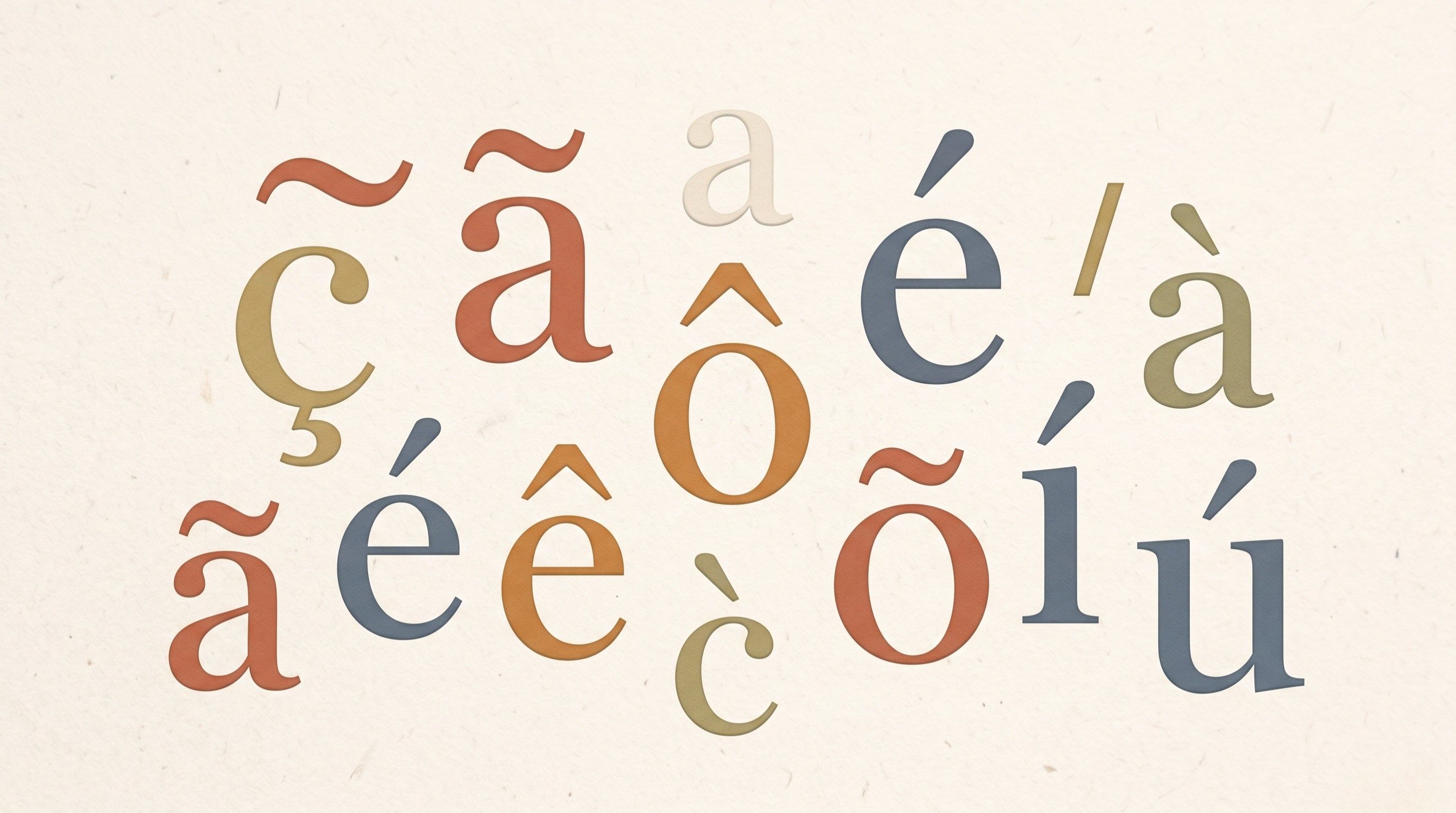
Portuguese accent marks are among the most information-rich features of the written language. A single small symbol above a vowel can tell you where to place stress, whether the vowel is open or closed, whether it is nasal, and even whether a grammatical contraction has taken place. For learners approaching Portuguese for the first time, these marks can feel like obstacles. With the right framework, they become tools — each one with a clear job to do. This guide covers all five Portuguese diacritics in depth, with pronunciation logic, practical examples, and notes on how European and Brazilian Portuguese differ in their usage.
Portuguese is a language with rich phonetic variation, and that variation extends well beyond written accent marks into the broader world of spoken accent study. Learners who want to explore what Portuguese English sounds like in practice will find the Portuguese accent generator at Accent Help a useful listening and practice resource alongside written diacritic study. The two approaches — written rules and spoken accent training — complement each other well.
Why Portuguese Uses Accent Marks
Portuguese, like French, Italian, and Spanish, adopted a Latin-based alphabet that originally contained only five vowel letters. The problem is that Portuguese developed far more than five distinct vowel sounds over time. Rather than invent new letters, the language chose a more economical solution: adding small diacritical marks above existing vowel letters to signal specific differences in quality, nasality, and stress placement.
This strategy is not unique to Portuguese. The same challenge arose across the Romance language family. As linguistics professor Paulo Chagas de Souza from the University of São Paulo explains, the key difference between languages is in which diacritics they adopted and how those marks are used. Spanish, for example, uses only the acute accent because its vowel system matches Latin more closely. French uses several marks and a digraph system. Portuguese developed its own solution, ending up with five diacritics that each carry specific phonetic meaning. Learners who are already familiar with how French or Spanish use accent marks will find useful parallels, and the French accent generator and the Spanish accent generator at Accent Help offer quick spoken comparisons between these related Romance language families.
The Five Portuguese Accent Marks at a Glance
Before going into detail on each mark, here is a quick reference table showing every Portuguese diacritic, the letters it modifies, and its primary pronunciation function.
| Mark | Name | Letters | Primary Function |
|---|---|---|---|
| á é í ó ú | Acute accent (acento agudo) | a, e, i, o, u | Marks stress + signals an open vowel quality |
| â ê ô | Circumflex accent (acento circunflexo) | a, e, o | Marks stress + signals a closed vowel quality |
| à | Grave accent (acento grave) | a | Marks grammatical contraction (crasis); signals an open a |
| ã õ | Tilde (til) | a, o | Signals nasalization of the vowel |
| ç | Cedilla (cedilha) | c | Converts a hard c sound into a soft s sound |
The Acute Accent (Acento Agudo): Open Vowels and Stress
The acute accent — the small mark that slopes up to the right over a vowel — performs two jobs at once in Portuguese. First, it signals that the vowel it sits on is the stressed syllable of the word. Second, it tells you that the vowel quality is open, meaning the mouth opens more during production than it would for the same letter without any mark. Words like fácil (easy), médico (doctor), and público (public) all carry acute accents that signal both stress and vowel openness together.
For learners coming from English, the concept of open versus closed vowels can feel abstract at first. A practical way to think about it is that open vowels feel more forward and wider in the mouth, while closed vowels feel tighter and more pulled back. The acute accent always points toward that open, wider quality. This is the same distinction that gives Portuguese much of its richness compared to English vowel patterns, and it is also part of why learners practicing spoken Portuguese benefit from contrasting it with related languages in the full Accent Help accent directory.
The Circumflex Accent (Acento Circunflexo): Closed Vowels and Stress
The circumflex looks like a small inverted V sitting above a vowel, and it signals the opposite quality from the acute accent. While the acute accent marks an open vowel, the circumflex marks a closed vowel on the stressed syllable, meaning the mouth stays in a slightly tighter position during the sound. Words like mês (month), avô (grandfather), and câmera (camera) all demonstrate how the circumflex works in real vocabulary.
The circumflex can appear over a, e, and o, which are the mid vowels in Portuguese. The high vowels i and u never carry a circumflex because they are inherently closed vowels and cannot be made more closed in any meaningful way. That constraint is a useful rule for learners: if you see a circumflex, it will always be on a, e, or o, never on i or u.
A concise way to remember the contrast: the acute accent (´) opens the vowel, and the circumflex (^) closes it. Both also mark stress on that syllable.
The Grave Accent (Acento Grave): Crasis and Grammatical Function
The grave accent in Portuguese has a narrower, more specialized role than the acute or circumflex. Unlike in French, where the grave accent marks multiple sounds on several letters, in modern Portuguese it appears almost exclusively on the letter a and signals a grammatical phenomenon called a crasis — the merging of the feminine definite article a with the preposition a to form à.
In practical terms, this means the grave accent is less about pure pronunciation and more about grammar. The sentence Fui à escola (I went to school) uses à because the preposition and article have merged. In Brazil, the pronunciation difference between a and à is minimal in everyday speech, but in European Portuguese the distinction in openness is more clearly audible. For learners, the grave accent is a reliable grammatical signal that a feminine noun with the definite article follows, which makes it a useful tool for both reading comprehension and writing accuracy.
The Tilde (Til): Nasalization
The tilde — the wavy line familiar from Spanish — signals something quite different in Portuguese than it does in Spanish. In Spanish, the tilde turns an n into the unique letter ñ. In Portuguese, the tilde sits over vowels (ã and õ) and signals that the vowel is nasal, meaning airflow moves through the nose during production rather than exclusively through the mouth.
The historical connection between the tilde and nasality is direct: the tilde originated as an abbreviated form of the letter n, which is itself a nasal consonant. In medieval manuscripts, scribes would write a nasal vowel and then place a small n above it to signal the nasal quality — eventually the n became stylized into the curved tilde we recognize today. Words like irmã (sister), pão (bread), and nação (nation) all demonstrate nasal vowel sounds marked by the tilde.
One important subtlety is that not every nasal vowel in Portuguese is marked with a tilde. Vowels followed by m or n before a consonant are also nasal without any special mark. Learners benefit from knowing both systems — the written tilde and the positional nasality rule — to decode Portuguese pronunciation fully. This kind of phonetic nuance is also what makes spoken Portuguese so distinctive compared with other Romance languages. Listening practice using accent generators for related languages such as the Spanish accent trainer or the Italian accent comparison tool can help sharpen the ear for the specific nasal quality that sets Portuguese apart.
The Cedilla (Cedilha): Softening the C
The cedilla is the small hook that hangs beneath the letter c, producing ç. Its function is straightforward and consistent: wherever you see ç, you pronounce it as a soft s sound, never as a hard k sound. Words like açúcar (sugar), coração (heart), and praça (square or plaza) all rely on the cedilla to signal that soft pronunciation.
The cedilla has a long history rooted in the Visigoth occupation of the Iberian Peninsula, and it originally represented a sound that did not exist in Latin. In medieval Portuguese, ç and ss represented different sounds, but over time most regional varieties merged them into a single s sound. The two spellings remained, however, because both reflected the Latin roots of the words. One reliable rule for learners: the cedilla only ever appears before the vowels a, o, and u. Before e and i, a plain c already produces the soft sound without any diacritic needed.
European Portuguese vs Brazilian Portuguese: Different Accent Mark Usage
One of the most practically important differences between European and Brazilian Portuguese is that they do not always use the same accent marks on the same words. The 1990 Portuguese Language Orthographic Agreement aimed to reduce these differences, but many distinctions remain in common usage. The key contrast is between the circumflex and the acute accent on certain stressed vowels: European Portuguese may use a circumflex on a closed vowel in a word where Brazilian Portuguese uses an acute accent on an open vowel, reflecting a genuine pronunciation difference between the two varieties.
This means a learner targeting Brazilian Portuguese and a learner targeting European Portuguese may be working from slightly different written models of the same word. If you are primarily interested in exploring how these two main varieties of Portuguese sound in contrast to each other, and how they relate to broader international accent patterns, the Accent Help regional accent directory offers a broad collection of spoken accent tools for comparison across languages and dialects.
How Accent Marks Signal Stress in Portuguese
One of the most useful roles of accent marks in Portuguese is to override the default stress rules. Portuguese, like Spanish, has a default pattern for where stress falls in a word based on the word's ending. When a word follows the default pattern, no accent mark is needed. When it does not, an accent mark is required to tell the reader where to place stress instead.
The default rule is roughly as follows: words ending in a vowel, -m, or -s are stressed on the second-to-last syllable. Words ending in a consonant other than m or s are stressed on the last syllable. Any word that does not follow this pattern needs a written accent mark to indicate the actual stress position. This is why a word like fácil needs an acute accent on the first syllable: it ends in a consonant but is stressed on the penultimate syllable, which breaks the default rule.
For learners, this means accent marks do double duty. They always tell you where the stress is and often tell you how the vowel sounds. Internalizing the default stress rules first makes the accent marks feel much more logical because you can see clearly which words follow the pattern without needing a mark and which ones deviate and require one.
Practical Tips for Learning Portuguese Accent Marks
Start With the Cedilla and Tilde
These two marks have the most consistent, rule-based behavior. The cedilla always makes a soft s. The tilde always signals a nasal vowel. Learning these two thoroughly gives you quick wins early in your study and builds confidence before moving into the more nuanced acute and circumflex distinctions.
Learn Open vs Closed Vowels Through Listening
The acute and circumflex distinction is best learned through the ear rather than through diagrams alone. Reading about open and closed vowels is useful, but pairing that reading with spoken practice is far more effective. Using spoken accent tools for related Romance languages — such as the French accent practice resource where the circumflex also appears, or the Spanish accent training page where the acute accent is the only diacritic used — can help you build the phonetic category before applying it to Portuguese specifically.
Memorize the Grave Accent as Grammar, Not Phonetics
Rather than trying to hear the grave accent as a distinct sound, treat it primarily as a written signal that a crasis has occurred. Recognizing à as a contracted article-plus-preposition will serve you better in reading and writing than trying to produce it as a categorically different vowel sound from plain a.
Study Minimal Pairs
Portuguese has several pairs of words that differ only in their accent mark and carry completely different meanings. Spending time on these minimal pairs makes both your reading and listening more accurate because you start to notice the distinction where it carries real semantic weight.
Use Both Written Study and Spoken Practice Together
Written rules explain the system. Spoken practice trains your ear and mouth to work within it. The two support each other, and combining them produces faster progress than either approach alone. Resources like the Portuguese accent practice tool and the broader Accent Help regional collection make it easy to move between written analysis and spoken reference without switching between entirely different platforms.
Frequently Asked Questions
Do I need to use accent marks when typing in Portuguese?
Yes. Accent marks are part of standard Portuguese spelling, and omitting them changes the meaning of some words and produces technically incorrect spelling in all cases. Most modern devices allow you to type Portuguese diacritics using keyboard shortcuts, long-press options on mobile, or dedicated Portuguese keyboard layouts.
Are Portuguese accent marks the same in Portugal and Brazil?
Mostly, but not entirely. The tilde, cedilla, and grave accent work the same way in both varieties. The acute and circumflex marks can differ on some words because European and Brazilian Portuguese pronounce the same vowels differently in certain contexts, leading to different written forms of those words. Learners should confirm which standard they are studying to avoid confusion.
Does the tilde always mark the stressed syllable?
No. The tilde specifically marks nasal vowel quality, but it does not always mark the primary stress in the word. Some words carry both a tilde on a nasal vowel and an acute accent elsewhere to mark stress separately. The two marks serve different functions and can coexist in the same word.
How does Portuguese compare with Spanish for accent marks?
Spanish uses only the acute accent as a diacritic on vowels, plus the tilde on n to create ñ. Portuguese uses a wider range: acute, circumflex, grave, tilde on vowels, and cedilla on c. The Portuguese system reflects a more complex vowel inventory, which is one reason Portuguese can sound noticeably more phonetically varied than Spanish to new learners. If you want to compare how the two languages sound in practice, the Spanish accent tool alongside the Portuguese accent tool gives you a quick spoken reference for both.
Can accent marks change the meaning of a word?
Yes, in some cases they can. A small number of Portuguese word pairs are spelled identically except for an accent mark, and the mark distinguishes their meaning entirely. This is one practical reason why mastering diacritics is not just an orthographic detail but a genuine comprehension skill.
Final Thoughts
Portuguese accent marks are not decorative. Each one carries real phonetic or grammatical information that helps both the reader and the writer communicate with precision. The acute accent opens a vowel and marks stress. The circumflex closes a vowel and marks stress. The grave accent signals a grammatical contraction. The tilde signals nasalization. The cedilla converts a hard consonant sound into a soft one. Together, these five marks give Portuguese its remarkable ability to encode complex vowel quality and stress information in a clean, readable script.
For learners who want to take their study beyond the written page and into spoken practice, exploring the Portuguese accent practice resource at Accent Help is a natural next step. And for those who want to explore the broader Romance language family and hear how accent marks connect to spoken vowel systems across French, Spanish, Italian, and other languages, the full Accent Help regional directory provides an accessible collection of tools for cross-language listening and comparison.